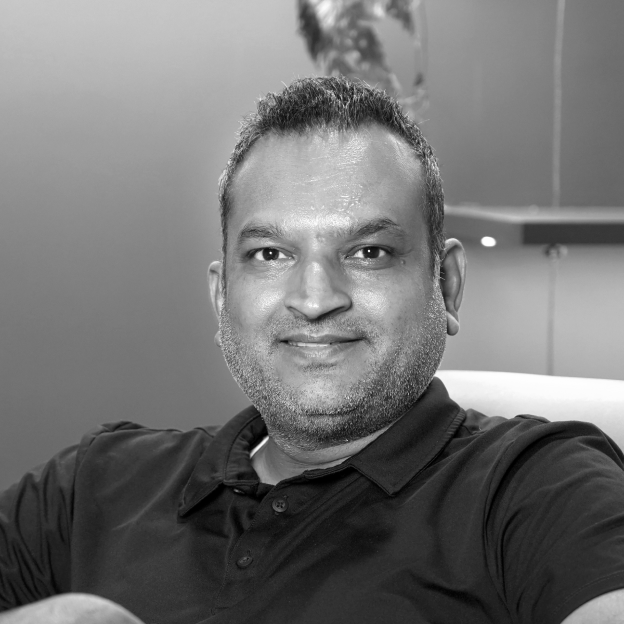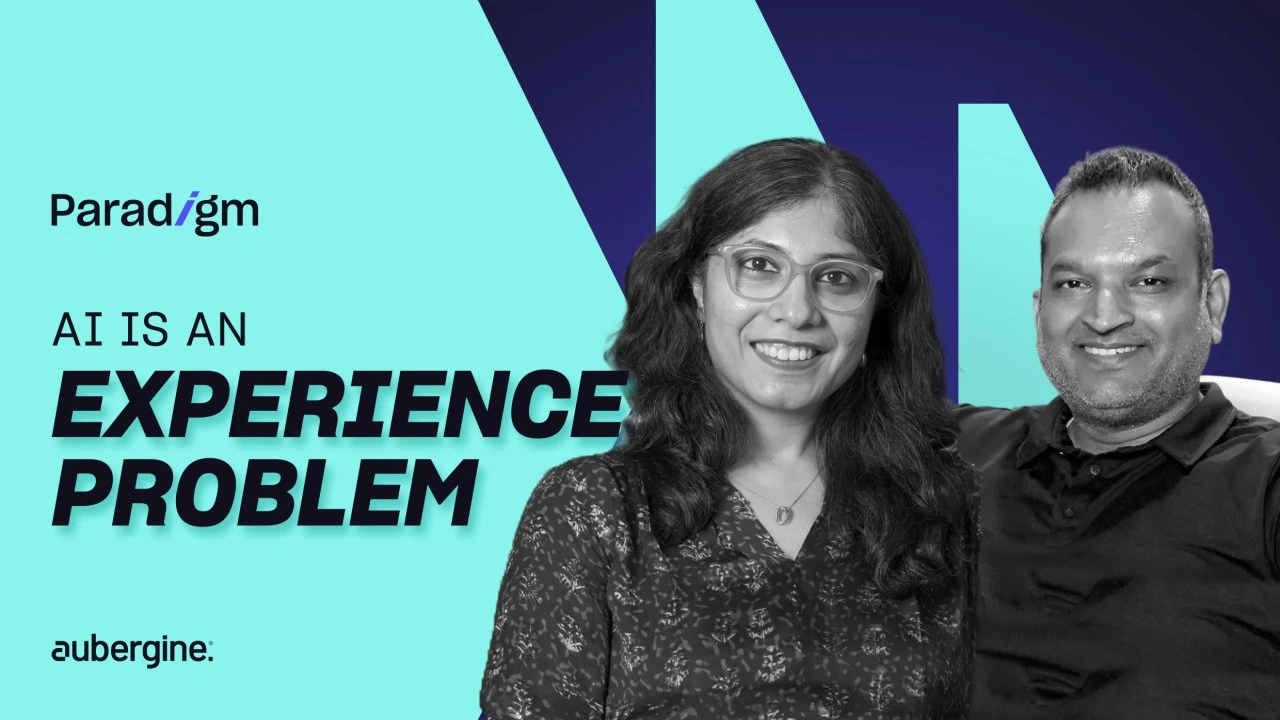

In this episode of Paradigm, we sit down with Neil Shah, Founder of DataOrb, a company working at the intersection of customer experience, first-party data, and cognitive AI. Neil has spent years building systems that help enterprises truly understand their customers, not through surveys or dashboards alone, but through the lived reality of conversations, behaviors, and interactions happening at massive scale.
After a successful exit with ezDI, a healthcare AI company, Neil turned his focus to a much harder problem: why organizations continue to misunderstand their customers despite having more data than ever. His work spans consumer tech, enterprise platforms, and global customer service environments, giving him a front-row seat to how customer context gets lost inside modern organizations.
Unlike popular narratives around AI being a purely technical or engineering challenge, Neil makes a clear case for a different framing. He argues that "AI is not an engineering problem, it’s an experience problem". Models may be accurate, but without trust, transparency, and usability, adoption stalls. In most enterprises, the failure of AI has less to do with data science and more to do with how humans experience and believe the system.
“AI moves fast. Trust doesn’t. Transparency is what bridges that gap.”
Neil Shah, Founder, DataOrb
Neil also shares how design thinking extends beyond screens — into team structures, documentation practices, global collaboration, and leadership mindset — and why design ultimately becomes the operating system for AI adoption.
The conversation explores:
- Why AI adoption fails without trust and transparency
- Why AI should be treated as an experience problem, not an engineering one
- How enterprises misread customer reality through surveys and partial signals
- Why design feeds engineering, not the other way around
- How verification turns AI skeptics into raving fans
- Designing AI products for global, multilingual, and diverse users
- Why upfront design saves time, money, and engineering effort
- How to think about AI transformation as insight → action → transformation
This episode is a grounded look at AI in the real world, where scale, uncertainty, human behavior, and trust matter more than demos or buzzwords. It’s a conversation for founders, product leaders, designers, and operators who are building systems meant to be used, believed, and relied upon.
About Paradigm
Paradigm is a podcast by Aubergine that explores transformative journeys where technology impacts human lives.Through candid conversations with visionary founders, product leaders, and innovators, we uncover stories of bringing ideas to life.


More ways to listen


Podcast Transcript

[00:11.6]
Welcome to our podcast today. How have you been doing today? Been good. Yeah. Thank you for inviting. As you know, our, podcast is called Paradigm. Here we talk about transformational journeys where people are using tech in many ways.
[00:27.5]
The challenges they face in building impactful tech which makes real difference in human lives. I look forward to this conversation and knowing a lot of things you have done in more than couple of decades of this journey. Let's start with your latest venture data or tell me more about what exactly you are doing over there.
[00:50.0]
Data Orb started with, very simple idea. You know, what we realize is that no employee goes to work to screw up their customers. Nobody says, okay, I'm going to start my day, I want to screw up five customers today.
[01:05.5]
Nobody does that. But the fact that it happens, that means there is some gap. Right? And so we identified that gap is the context. People don't have the customer context. The customer context is stuck in emails and chat and conversations.
[01:24.8]
And so the idea was that if we can unlock that context and give it to every individual, whether they are sales, marketing, product design, we can empower them, enable them to act, in a way which delivers that customer empathy.
[01:46.3]
And yeah, that's it. That was the very simple idea and we started it over. So basically you wanted a, system which can listen the customer voice, correct? Yes, as much as possible, with as much accuracy as possible.
[02:05.1]
That's so beautiful because it empowers the business decision makers to focus on the right problems instead of assuming what's working or not working for their customers. That's great. How have you gone about forming or transforming the idea into reality?
[02:25.7]
Great. Question. And it's hard. It's one thing to think about the idea, and it's another thing to build it into a company and get customers.
[02:40.1]
We started, exploring this with a couple of, leading brands. You know, we went after the consumer brands first because we thought they would deeply care about their customer experience. So we went after a company that builds, virtual reality headset, a social media company, and a company that builds a streaming device.
[03:02.7]
And you know, we very quickly we realized that they all wanted to know and they wanted to know more. Why does my product work? Why does it not work?
[03:18.0]
Why do people buy? Why do they not buy? What kind of experiences are they having? You know, how are they forming communities around my product? Right. There's so much that they want to know and the data was stuck. So, and then, at the same time there Was also a lot of fear, of how to get it right.
[03:37.4]
Right. Because there is no humanly possible way that you can analyze this data. Right. It will take army of people. Right. Like if I'm talking about let's say a single telco, a large scale, let's say about if they have 30 million customers, you're looking at about 200,000 hours of audio data.
[03:56.1]
Yeah. Right. You're looking at between 30 to 50 million interactions. So the scale is massive. Right. And it's critical that you know when you they all want to know but they also want to make sure that how reliable would that be?
[04:11.5]
Right. Because keep in mind that they are doing the CSET and NPS surveys today to know more about their customer. Yeah. The problem is most people don't write CSAT and NPS. Right. Only 0.00 some percentage and that based on that data you're asking them to make a decision.
[04:32.7]
The other problem is also like when you have a batch service and somebody sends a survey, how did we do? I mean like come on guys, like I've been calling you for five times, you haven't fixed my problem and you what, it's completely meaningless because those things are broken. So I think that you know we we had a lot of learning from my previous venture that I did in healthcare.
[04:54.6]
AI is to how to make AI verifiable, accountable. So we took a lot of those learnings, put it in data or build the one of a kind platform that understands the customer context and does not require the keyword and the taxonomy and we build it to understand about 80 plus languages because a lot of brands that we are working with, they're global.
[05:21.0]
Right. And so instead of building a point solution that okay, this is for my Spanish, this is for French, this is for my Korean. We build a single platform so the entire customer community, it's on a one platform and they can understand it. But yeah, it took us about three to four years to build that out.
[05:41.6]
We are live in about 40 countries today and supporting some great brands in finance and energy and telco. So help me get more context here. You know what type of data do we process?
[05:58.7]
Like is it customer interaction, is it customer feedback, is it static? I think you mentioned audio files. Right. So just for better understanding and giving context to the audience also you know there's so many ways customer interact to the brand, to the you know, company and they give feedback in some or the other format.
[06:23.5]
And it's so vast, no human can actually process and hence the need of AI for it. So help me understand the breadth and depth of the AI as tech and what role it plays here. So we look at the at a broad level.
[06:39.3]
You can say you have a pre purchase stage and there are a lot of interactions that happen at a pre purchase. Right. You are interacting with a, chatbot. Hey, do you have this, let's say this shirt available in so and so color?
[06:55.0]
To asking somebody on Reddit, you know, what do you think about this, you know, phone company, should I buy their mobile phone or like should I buy this? Right. So you have a different type of conversation then you have during purchase, let's say you are not able to check out from the cart or you order five items and only four was showing up, but the fifth was not.
[07:17.9]
So you're reaching out to the brand and then post, purchase, you know, let's say, you got delivery on time or you not get delivery on time, items are missed. Now this is different for every, for banking, it looks very different.
[07:33.8]
For our health care customers, it looks very different. For energy, it looks very different. For telcos, it looks very different. We have automotive, that looks very different. Right. So know ev, for example, okay, how much credit would I get, from the government? How do I file the paperwork?
[07:50.6]
Where is my ev? What's the maintenance look like? What's the. So all of these conversations are happening across the board. We collect all of them, correct? Right. So the whole, the, the idea is that no data is left behind, no context is left behind. Wherever we can get the context, we'll go get it.
[08:08.5]
So whether it's on the Reddit and X, whether it is on the calls, whether it is emails and tickets, chatbots, voice bots, we collect all of them. So much data to process, correct? Yes. And AI does the magic of connecting the dots, distilling it, making sense out of it, channelizing it, maybe surfacing trends and helping the decision makers or the stakeholders understand, okay, this is the most common problem.
[08:39.7]
Let me focus and try to solve it right now in the back end. As a tech, I know there is a lot of heavy lifting done from the technology perspective. What's your experience in terms of translating that into an actual interface?
[08:57.0]
You have many stakeholders who end up actually using this system. Who are they? What are their goals? So what happens is that you are sitting on all this data. Yeah. But Your decisions are made based on what happened six months ago, 10 months ago, 12 months ago, because the data is just sitting, nobody's analyzing and giving you the real time pulse.
[09:19.4]
And so for us, the transformation is all about compressing the feedback loop. The overall entire feedback loop. You want to compress it. Right. So that's one big Lego piece. Yeah. Then, okay, what do you do after you compress that? Right.
[09:34.6]
So we have sort of three stages. You know, speed to insight, speed to action. Right. So you have speed to insight, insight to action, action to transformation. So we have a very well defined framework. How are we going to do that? Right. And at every stage of that transformation journey, you want to minimize the risk.
[09:53.3]
Yes, of course, the risk from the point of view of the investment that the brands have to make. You are always dealing with skeptics, and people who enjoy using AI. So you also have to cater both in any given company. So you cannot just say, okay, yeah, today we are bringing AI.
[10:10.6]
All right? Everybody adopt. Doesn't happen that way. Right. So for us, it's an experience problem. Yeah. Right. So, early on, again, you know, we engaged Aber Jean. Thank you. And we love working with your team.
[10:29.2]
And we sat down, like, what are the fundamentals that we needed to get right? And for us, the key thing was that how do we make AI accountable from the user's experience point of view? That the skeptics, when they log in, when they join, when they're looking at, okay, AI has done this, it is saying that the customer is likely to churn or customer had a negative experience with the brand.
[10:56.0]
And, okay, how do we make sure that the user, they can, they can trust it. Right. So we work, relentlessly on building out experiences that allows users to verify. And that's how these skeptics became the, what do you call, raving fans.
[11:15.4]
Because we are, and I always say to this to my customers and prospects, we are the most open system in the market. Yeah, right. You can, you can evaluate every aspect of AI because, we are making sure that you have access to all the tools.
[11:31.2]
So it was not an afterthought. We build it from that, from ground up. That, okay. At the end of the day, we thought that, you know, the skeptics will eventually be converted into raving fans if we give them the right tools. Because in the industry, we are now the, the company that delivers, all these insights that are, that are end to end, verifiable.
[11:52.3]
Awesome. So there is a journey or transformation of Users being a skeptic, correct. To trusting the system and being more of an advocate of it because they actually found something which they themselves cannot really find.
[12:08.5]
And one of the challenges that we have is that we operate in many countries. Right. So the way people think in Spain are very different, than the way people think in Korea or the way people think in France or Italy.
[12:24.1]
And so we needed to build a global system. And the interface has to also transform that how we are going to communicate with different people. So it's a multilingual interface and all that. And the one common theme that we found across doesn't matter, but which part of the world you go to, the AI adoption is real.
[12:45.1]
Everybody knows that AI is coming. Everybody loves it. And the experience that we build where it is easy to verify the entire trail and making AI accountable made it very easy to drive adoption across the board. Again, thank you. I mean your team did a phenomenal job.
[13:00.9]
Yeah. So let's talk about translating this into the experience layer that you have been talking about. There have been, I think we are operating DataOps since almost four or five years now. Four years, yeah. Yeah. Right. And you made a choice, a conscious choice of having partner like us take care of the design first.
[13:23.4]
Yeah. And there must be something, some reason why you chose that help me understand, you know, why you decided that it has to be a design first product and why even with strong AI, design and experience is still critical in building this product so that it gets adopted.
[13:43.0]
You know, when I take a step back and this is one of the things that I told, one of the individuals that's working with us from Aubergine, we don't think AI as an engineering problem. We think AI is an experience problem.
[13:59.7]
Right. And we were very convinced that AI is an experience problem and it is going to be an experience problem. Right. So we don't think from the engineering point of view, first of all. Right. At the end of the day you want to build a system that a 18 year old kid can use it.
[14:19.9]
I wouldn't go to 13 or 10 because. But I'll stick with 18 and above. To a 65 year old person can use it. I see. And you need the level of, you need the experience to deliver that level of trust, empathy, those things are very critical.
[14:43.2]
So for us AI is not an engineering problem, it's a design problem. Right. It's an experience problem. That was the first thing. The second is if I'm a product company. Know what's my product? It's the experience that I deliver. So design is a very central part of it.
[15:01.8]
And I've known you since I don't know how long. Right. We've been to, we've done a bunch of 13, 14 years. So yeah, you've been obvious choice but I know over the period of years that you know, the frameworks that you have built, to stay ahead on the design to ensure that help companies go through the sort of Enterprise to SaaS to now AI first or AI Native Company and the kind of experience standards that we need.
[15:32.7]
Some of the standards are still same. Right. Whether it is to think about accessibility from the lens of AI, what does that look like? Because you still have to account for those things. Right. And so Aubergine was an obvious source. Not only we know each other for a long time.
[15:49.0]
That's putting that aside. And of course the way we came to know each other is because we were trying to solve a design problem in our healthcare AI company. And so and I think since then, every time it just you know, the relationship has been growing and we are very thankful of all the work that you're doing.
[16:10.6]
And you know, I tell your team that we where I see Aubergine being super helpful is that there are many aspects which are tactical and that's fine. Right. And tactical is okay, you get it. Right. But there is also other areas which are very strategic for us and one part of that being unknown.
[16:30.3]
Of unknown. Right. Like how do you make sure that you have the right people working on the right problem? So you reduce the number of blind spots that you are likely to have and that requires some level of design mindset, the experience. That's what your team design thinks.
[16:45.8]
Yes. That's what your team brings to the table. And so for us it was an obvious choice. Yes. That's great. There is so much nuances to just working with designers. Good to know that you have identified some of these areas for Data Orb.
[17:04.2]
And we are working now. Now my turn. Yes, go ahead. Now you've been Chief Design Officer, right? You've been designer all your life? Yeah. What do you think? I mean we can't figure out what design is. What is design from your perspective, your point of view?
[17:20.3]
Design for me is the way you think. Design as I understand is a tool that helps you focus and get clarity. My personal journey has been about applying design thinking in anything that comes my way.
[17:44.7]
So I started applying design thinking in building digital products, then in building teams, then in mentoring them and then I started applying it in building, you know, the HR team and the marketing team and the business team and the operations team and the whole business I'm running now.
[18:04.8]
I'm applying my design thinking lens. One superpower that this thinking gives is the confidence of I will figure it out. As you mentioned, the unknown unknowns, the whole equation of I don't know what I don't know.
[18:24.1]
Design thinking is a tool that helps you navigate that. So to me it's a superpower which has unlocked a confidence that if I have a vision and I want to reach there, this tool will help me find my way out.
[18:41.7]
And how are you thinking? Because I'm sure you're working on many projects, you know, the AI is a reality and you can't ignore. Right. How do you think it will shape not the tooling but the experience that the users are going to have?
[19:04.3]
And what are some of the things that you believe that companies building an AI has to watch out for as we transition from sort of the work building a workflow system versus where the workflow almost runs in the background today? Yeah, it's going to be a, transformation we all probably are going to witness.
[19:27.5]
Interfaces most likely won't look the way they used to look. You know, interfaces could like. I think we all have now experienced so many tools where we are just conversing so it's becoming more conversational.
[19:43.8]
But it will go way beyond that. It might just transform in many different ways. The way you see the data, or the way you manifest it and what you show, why you show and how you empower people, those are going to be more critical.
[20:01.1]
Yeah. I do feel the design is going to become even more integral part of it because what comes out, could, could help somebody diagnose someone better. Yes. Or completely misdiagnosed.
[20:17.5]
Right. And absolutely. Or help someone really learn how to do so and so problem solving. Whereas. So you're right on. I think that, that the, the feedback loop to. So how do you verify what comes out?
[20:33.5]
Yes. And because what goes in could also be biased. Exactly. And that's where the transparency layer in the interface is going to play a very important role. You know, if the transparency is there and if it will help in trust.
[20:49.0]
Because with AI, trust is going to, AI is going to move fast. Humans have their own speed in which they Will adapt to it. Right. And trust takes time. Right. Between two humans, it takes time between, between human and AI.
[21:05.2]
It will take probably more time. Absolutely. Right. So hopefully by the time that trust is established, you know, when AI is throwing something in front of a human, the transparency layer, which will help bridge that trust gap, is going to be critical.
[21:23.2]
Let's try to zoom in a little bit into the entire design process as you understand it. And what's your take on what has worked when it comes to the design process? Yeah, great question.
[21:40.2]
I think the way we look at design process, I think I'm going to kind of draw some parallels so maybe it's easy to understand. Now think about you're making a movie. You took everybody's dates, you're shooting it, you did all the music and everything.
[21:59.0]
And now you're in the post production. Right. And you're doing your final edits and all that. It's very difficult and very expensive to bring all those actors back, do the reshoot. It kills your budget. Yeah, yeah, right. It's a kind of the most expensive mistake you can make is that try to fix it on the post production side of it.
[22:20.8]
Right. Now take a step back on and let's look at the design. Right, so design feeds engineering. Yeah. Right. So post production is that you are trying to fix a lot of things on the engineering side. Yeah. Right.
[22:36.9]
And that's expensive because they could be working on the next and the next and the next and delivering value to the customer. So the way we look at it is sort of the, the just like in, when you look at the. How do you do perfect the movie studio side?
[22:54.0]
Well, you do storyboarding, you, you go through every shot possible, you do narration. Right. And you do a lot of prep work up front. Correct, Right. So that those and then you are taking retakes and whatnot. But like it's like you try to perfect that so you have a.
[23:10.9]
Iterating at sketch level iteration. Yes. Yeah. So you go through many cycles to make sure that the, the final is as perfected, storyline is frozen approaches aligned. Yes. Correct. Right. And then we are integrating the whole AI.
[23:28.1]
How would the you know, design and AI kind of like how does that come together? So is it going to be the AI as an autonomous system, AI as a collaborative system, AI as an interactive system? Right. And the way I define that is like autonomous is when I'm delegating, AI completes the work, doesn't require my feedback and I review the Final results.
[23:50.3]
Okay. Interactive, is that the multimodal AI that allows me to interact with the specific object, and modify and manipulate, interactive and collaborative.
[24:06.1]
They are kind of same but they differentiate from the perspective of the building out, let's say collaborative slides. They look very, collaboratively working out slides that look very different versus you are sort of trying to solve let's say a specific component problem, to the interaction with AI.
[24:30.5]
Okay, again, take a step back. These are the three ways people interact with AI, at least for us. These are some of the ways, and now we are looking at. Okay, what would be the whole multimodal experience would look like? Like what if. Because on the, you know, keyboard and mouse is different versus the minute you are introducing voice, that experience changes.
[24:50.8]
Correct. Right. Because voice experience requires shorter dialogue. Shorter conversations. Yeah. How do you do verification on that? So there are a lot of challenges. Then we are also thinking through images and the videos. Right. Like how does that blends into that. Too many media. Yeah, exactly.
[25:06.3]
So you are, you know, multiple mediums out there. Yeah. So going back to the design process. So for, for us it is important that you know, the, the we want, we don't want to make mistakes at the engineering level. Right. So as a result what happens is that the we. We design the process in such a way where we are spending more and more time iterating at the design stage.
[25:28.5]
And we take a lot of pride in terms of the amount of, you know, some people might call it waste. We call it the important work. That 80% goes into that sort of archive and that 20% is what remains. And we take a lot of pride.
[25:44.7]
It's golden. Because that 80% made you reach this 20%. The learnings of what is not working is feeding into what is working. So the paper iteration level equivalent to the movie making.
[26:01.3]
Yes. Is the design iterations for the digital products low cost because you are not developing everything. Correct. Still ideating, testing, validating, maybe throwing away. If it is not working for us. It's important that we, our process actually allows for that.
[26:19.1]
Right. So suppose if you are going to like we have some designs from 2022, 2023 that we work with your team, that we are bringing back in 2025. Either the technology was not available at that point or we were not getting to the idea that we needed to get to.
[26:37.1]
So we might have spent six months on a bunch of different drawings and sketches. And it's perfectly okay because that is how you kind of like you build that sort of the product that works for the user. The amount of iteration helps us be very comparative because it's sort of like you're doing a first principle thinking, right?
[26:55.4]
You are doing original thinking from the point of view of like, okay, how does this user journey evolve? And any user journey, right, you look at, there are multiple ways to actually deliver, right. There's not only like, okay, step one, step two, step three, there's no right and wrong, but there are just many ways.
[27:12.0]
There are many ways to get there and you have to figure out which way works the most, I guess. Yes, exactly. Well, you also want to unlearn lot of things, right? So the, let's say prior to this I built a SaaS company, right. Software as a service. So I'm doing a lot of unlearning from the software as a service.
[27:29.1]
Because when the feedback loop on the software as a service, right. The AI loops were not as robust, the data loops were not as robust. Today we can anticipate a lot, when exactly the user is initiating the journey at that point, what's important for the user, what would that micro loop would look like that gives you the new data point that triggers the next journey for the user.
[27:56.6]
So all this diversion that how do you get your user to do from A, B and C, you know, that's constantly evolving because you have access to new technology and new tools. Got it. But you need to then incorporate from the design point of view.
[28:11.8]
Okay, how does that going to work? And at every stage, does the user need verification? And these are complex problems, right. And that requires that you go through that iteration. And as a result what happens is that we are saving thousands of dollars.
[28:30.8]
Right. From the product engineering point of view. Absolutely. So you are iterating design level. Exactly. Engineering level. Because otherwise think about it, you ship a wrong feature, you take it down, and then you rebuild the cost of that building the wrong building that.
[28:48.2]
And the cost is in time. Now today, the competition is not measured in terms of like okay, how many years of advantage I have over my competition or like whatever market that I'm building towards, or in general, like how few fast, you know, things are, everything is moving very fast.
[29:07.4]
So you're missing out on that advantage of like you know, you did the time right. Like so the things are evolving pretty much every 24 hours a week, month, but it's no longer about years.
[29:23.5]
Right. And so if you miss the mark. Yes. Then not only you, the engineering cost, but the time that you lost. Yes. So I think that that's like design gives you that moat of finding that unique solution.
[29:40.0]
Absolutely. And differentiate from the competitors. Absolutely. And it's not an either or kind of situation as well. Right. Because you are winning the users. Correct. At the end of the day you want to win for the user. Right? Yes. And as you win for the user, it already creates a competitive advantage for you.
[29:56.4]
Absolutely. So it's the way we, for us the lens is the user. And you know, it's like you know, do you play offense or do you play defense with AI? Right. I can look at AI or I can look at design as okay, I'm going to cut cost, save cost. Like you know, that's you don't look at, you want to play offense because when you play offense, the defense is free.
[30:15.4]
Yeah. Makes sense. If I'm building for users and then that, that it works for them. Yes. I already have a competitive advantage. So let's take some of these recent innovative solutions that we have built at Data or when you put it out there in front of real customer, they are making a purchase decision.
[30:37.5]
How have you seen design playing a role in selling the product? How does the mindset of the customer connect the dots with the design part when they are making that purchase choice? Yes.
[30:52.9]
The user may not recognize that, but what you get from the user is that one, they chose you over others. Yes. Right. And that smile that I get it, I get your system. We don't have to worry about building out like today when you look at data or you have no hundred page manual like how to use the platform.
[31:13.8]
We are doing workshops and we are letting the user know how to benefit from different insights and different data, points that we are collecting. But the conversation is very different, from okay, you click here, you click there to training how to use this customer insight and what kind of transformation that you can drive now.
[31:36.4]
That is the power that design brings. Correct. So you don't, you're not training them on how to use the product. The intuitiveness, they just get it. Yes. You are just trying to connect the dots between the insights gathered and then the actions may be the action they're into. Yes, exactly. Or decisions they can make from it.
[31:52.9]
Correct. And see for us these are the harder problems. Right. So it's not like it's not one problem that is hard. And then okay, you say okay, this is a hard problem. Let's bring in the design team and do it. It's like the oldest pieces. They all, they have to come together, right. The, the Persona and their journey, the decisions they have to make across the journey.
[32:12.9]
What would be the, the, the information hierarchy? How am I going to use the intelligence the data brings or the AI brings? What is the right aesthetics? That would work. How would the multiple languages would fit into this? Because you know, even the, the UX copy you have to think about because if you're using translator.
[32:32.0]
Right. And you know like every word doesn't translate the same way. Right. So designers also have to be they need to account for those scenarios. Right. So for us it's a combination of all that that helps us do what we are doing today and be be successful and be competitive in the market.
[32:50.5]
Awesome. Okay, let's talk about the best compliment you have received. Let's say, you know, some of the customers must have been using this for some period of time. Any really nice compliments that the product have, has received that you can share?
[33:07.4]
Yeah, yesterday I was on a call with one of the prospects that they're piloting the system. English is not their first language. All they said your user experience, very good.
[33:28.5]
And for me that brings so much of a smile and you know, we feel proud because we are not you know, see as a company there are problems that you want to work on. Correct.
[33:43.8]
Because that brings, that makes your company go forward. Correct. Right. And then you're innovating. You don't want to be solving problems, that brings you down. Correct. And so for us when you talk about the customer, feedback or things that we hear from the customer are this, that you know, how intuitive it is.
[34:07.4]
Because that first experience. That first time login. Correct. Right. This is the. When they're buying a product and we are giving them access to the sandbox that we have during the pilot or the proof of concept, they're logging in first impression they're going through that and when they come back and say your user experience.
[34:32.0]
Very good. Like okay, all right. So that is checked. Yes. And that goes a long way. Because what does that tell you? That tells you because we are building an enterprise product. Right? Yeah. In the enterprise, you have to drive adoption.
[34:47.6]
This solves the adoption problem. For us big time. Designing For a complex enterprise product is easier said than done. Not many designers get it right.
[35:03.6]
Now you as a founder always have a choice to hire somebody in house, within your team, and run the show. When it comes to design, right. What makes you choose a partner like us instead of hiring in house?
[35:22.4]
We do have a choice, right? We are not a design company. We are a product company. Design is super important for us. You are a design company. You. So the, and we have had a lot of these debates internally as well.
[35:40.9]
Right. We can do many things, but we are not going to be expert or experts in everything. And at such a stage, when you are trying to build, the product, making sure you get things right, get your product market fit, design plays an important part.
[36:02.5]
Right? And so for us, you know, the selecting or going with the experts that are in their field, was an obvious choice and that we made. But there are also other things that comes with it. Right. One is that the, you know, you are giving the designers the environment that we would never be able to.
[36:25.3]
We would not have 100 designers in the team. We are a product company would have few. And so it's also important that designers learn from Other designers, they understand, multiple And we also think that the designers get better and better as they go through their own iteration of designs.
[36:40.9]
Absolutely. And so for us, we knew where our expertise work. Right. On the engineering side, on the machine learning and the AI side, on the product management side and things like that. And design was not. Design is where we brought in the expert. Right. And that is how at least we came to the conclusion.
[36:58.9]
Awesome. Thank you for all the trust in all these years. I really appreciate. And of course we have also enjoyed not just working, but all the challenges on the way, the nuances. You know, every time there is a new thing and a new perspective we are trying to work on.
[37:18.0]
What brings satisfaction to me and my team is ultimately we are all striving to an excellence level, building something that we are all going to be proud of even a decade down the line or more than that, you know, really, really exceeding, you know, the expectations, building something nobody has done.
[37:39.5]
Really excited about that always. Let's, talk a little bit about the future of Data Warp. Since we are talking about AI interactions, new age, lot of new ways people are interacting with products these days.
[37:55.1]
What does the next chapter in data look like? What type of design or interactive experiences you are looking forward to? I know there is, a. There's a lot of talk right now going on, in India, to build for the world,
[38:18.8]
before this talk, happened, right, this, you know, One of the sort of the underlying idea. You know I of course I work from Chicago. My co founder works from Ireland.
[38:35.8]
The other person in the founding team, he works from Mexico. We have people in Nicaragua and of course in Andabad. We are like, we are fully remote team. But I grew up in Ahmedabad. Right. So there are so many like my roots are in India and so our vision is to build for the world.
[38:52.2]
We want to build for the world and that's the next set of challenge for us as data or that's how we see the future. But can we actually be you know, sitting in Ahmedabad, great team. Can we build for the world?
[39:07.7]
Awesome. You know we are live in many, many countries today. About 40. And we're going to continue to expand. And that's the next chapter, right. I think with that chapter, as I said I've been keep saying right that the AI is an experience problem.
[39:25.2]
So I think as you tackle different region, we're going to face different challenges. Language. Language. Language being the number one. Right. And then the of course the experience. Right. Whether it's a, which modality of the experience that you are delivering.
[39:41.4]
Text, interactive, voice. So many ways people manifest the interface and preferences are different. Exactly. I mean imagine that if you are selling in you know, just give you an example. Let's say you are in tier two city right now, right? I'm now this tier two. Correct. I guess. Right. Versus Let's say you go into a little village in Ahmedabad, right.
[40:00.0]
You're you're selling to them. The, the experience means two different things. Correct. For those two different. And as a, as a, as an entrepreneur or as a product person, you need to acknowledge and recognize and empathize with that.
[40:17.2]
And so that's why like you know the design is such an important area. Because from the product point of view, okay, I'm delivering this function and this function. They're my users actually. They are not. They are nothing. They don't look like same.
[40:32.7]
They're not going to use the product the same way. Yes, yes, yes. So how, how do you. I have two very interesting questions from this that spin off my mind. One is related to designing or building for global audience. You know, building a product for entire world.
[40:51.3]
You know, what are the challenges and nuances that you know, you are facing and how are you even managing and overcoming those? Because language I think you mentioned is one. What other challenges you face. Because building for a Global audience is not at all easy.
[41:08.7]
Yeah. It's I think the language, It's not just the translation part. The language is everything. Right. Like when I say language it's not. I'm just talking about how they say this word and this. Right.
[41:23.9]
What is the. I'll give you a, give you an example. Right. We have this user interface that I think we have spent most time with your team to kind of get it right. Right. And it has multiple pieces on that user interface.
[41:39.0]
Yeah. We have the entire conversation. We have the audio player if there was an audio conversation on the other side. We have the different types of insights that we have derived from that conversation and interaction where people can easily verify where does the insight come from.
[41:56.1]
And that. And that's like a last mile solution when people are in doubt. Why are they saying this to me? That why this customer is going to churn. They click and they land on this interface. Right. Now you know when I'm building this for let's say the languages that are left to right.
[42:16.4]
Yeah. Things look very different. Very different. Where the filters are, where the buttons are, where the entire, all these components, where they are. Flip, flip it, go right to left. Yeah. Now how do you design an interface that accounts for both of those?
[42:34.3]
Now take that to dashboards and everything that you have Right. Where your filter positions are versus where. So the let's say color selection. Correct. And what does that color mean in a given culture? How does that impact?
[42:50.9]
Colors have a huge. Right. So what's going to be your thought process around that area? Yeah. Right. And then at the same time, you know the, of course the accessibility is also key. Right. And you have to constantly account for those scenarios as well.
[43:06.5]
So even though the, let's say the. You're translating the language changes, you're reorganizing all these components, it shouldn't violate all the accessibility. Yeah. So it's very complex. UX copy itself. Yeah. UX copy is very critical too. Translate into a very long string and you don't have enough space.
[43:24.3]
And I think there was a particular word. I remember we had to work with your team. I think it was on filters and we had this normal thing to do is reset. Right. Doesn't really translate well in other languages.
[43:42.7]
Yes. Right. For example we came to a conclusion working with your team on one of the interactive experience that we have, product naming and we design the product Logo and all of that.
[43:58.3]
Right. Called Ask Mira. And we chose the word Mira because if we. The Mira works across many, many languages. Yes. And it has a, it holds true whether I'm in Korea, I'm in Spain, I'm in France.
[44:18.0]
It. Right, correct. So I think design goes beyond. So these are like a, these are of many challenges that we face. And, lot of time you think, okay, you know, it's just a page. Well, no, there is so much, there is so much that goes into it.
[44:33.5]
Goes into it, Right, Nice. So great. So the second thing that comes to my mind when I hear you is what does it take to work as a global team? Like you two founders, three founders, co founders, everybody you said is remote, working in different time zones.
[44:51.6]
True global team building for global audience. So how do you even make it happen working as a global team? What are the benefits you get out of it and how do you navigate that landscape? The, idea Sandeep and I, my co founder and I, we had was very clear that there are specific problems that we want to solve.
[45:13.3]
That is why we are building. Otherwise it's not worth. See, like, we recognize very clearly that we have one life. We want to do something meaningful. Otherwise, what's the point? You can go do a job somewhere like, don't build mediocre products, don't build products that, okay, I'm just going to do little bit better and then sell 10 times cheaper and then I'll make money.
[45:33.4]
That's not. So then what happens was that what happened at that point is that as you bring in more and more people, they get attached, to that mission that you have as a company. Like, okay, what are you trying to do? Why are we doing? What are we building?
[45:48.8]
Why it's important for us to build. And this is what we talk to our customers too sometimes when they come up with, can you solve this problem? Like, okay, we can solve, but are, there others solving it? Then you probably better off buying from them. The reason that we do that is because, like, if they're already sell, unless it's very strategic and it makes sense that, okay, it connects with our product and we can do that.
[46:10.5]
We also brought in the first group of people that we brought was someone that we have worked in the past and you know, kind of like, okay, hey, this is what we are doing. Do, you want to join the journey? People join the journey and it's okay. They get off when it's time. Right. So it is a cycle.
[46:27.3]
The second Thing is, I think there's a lot of documentation. Yeah. That's involved.
[46:36.6]
We document like crazy so everybody can work in their own time. I'm traveling, is traveling. Different time zones, people collaborating, different, you know, so the offline community offline communication and collaboration because became a key, those two.
[46:55.1]
And then third is that we're also giving a lot of our employees the, the direct connection to customers. So when they hear the pain point that the customers have and when they hear that how what they build solves that, it's a different type of, you know, that they're getting the opportunity because a lot of time what happens, like as a software engineer, you know, you are you.
[47:18.9]
Not everyone gets an exposure of how the customers are benefiting from what I've built. Right. How is it improving their life and their team's life. Right. Are they having a 10 hour per week saving? What does that mean?
[47:34.9]
Does that mean that they can have a dinner with their family at least one time a week because they are not stuck at the office and so kind of like driving that story? That's very important. So I think those are the three things I would say like as work for us. That's great.
[47:50.2]
There is so much, so much to learn here for anybody building a global team which is becoming a norm these days. Any concluding thoughts you want to add? No, I think first of all, thank you for inviting me on your podcast.
[48:05.4]
I'm a pleasure. Aubergine for us has been one of the best partners, the best investments that I've made in my life, and has paid dividends and will continue to pay dividends. And so for us this is sort of the way we look at it is that for us the next five years or the 10 years, for us the design is at the center of it and our gene is at the center of that design.
[48:38.3]
Right. So, so thank you, to you and your team. And I know you have grown quite a lot. So congratulations. Thank you, thank you. Blessings from you know, great people we got to work with. What I appreciate of the journey so far has been, you know, I always say this, you know, analogy of any journey.
[49:02.1]
For me personally what drives me is solving many problems. You know, I was never able to imagine myself focusing on just one product. I am more like a, I'll solve this problem and then I move on to another problem, not half solved, but trying to impact as much as I can.
[49:26.5]
And in this whole journey, what has driven me personally has not been just the journey itself. I don't see there is just one destination also. I feel there are so many milestones and so many destinations and, you know, stops that we make on this way.
[49:48.4]
And for me it's so many of them. So what I always take away are the people who walk with me. So for me the journey is about everybody around me who is walking with me and the difference we all make in our lives on the way.
[50:08.4]
That has been one of the best thing and you are one of those amazing people I have found in this journey. I have also learned so much from you. And I look forward to solving great problems. Absolutely. Let's clear a lot of impact in real humans through tech.
[50:26.6]
Absolutely. Thank you. Thank you so much for joining us today. Thank you.
Host

Bhakti Dudhara

Guests