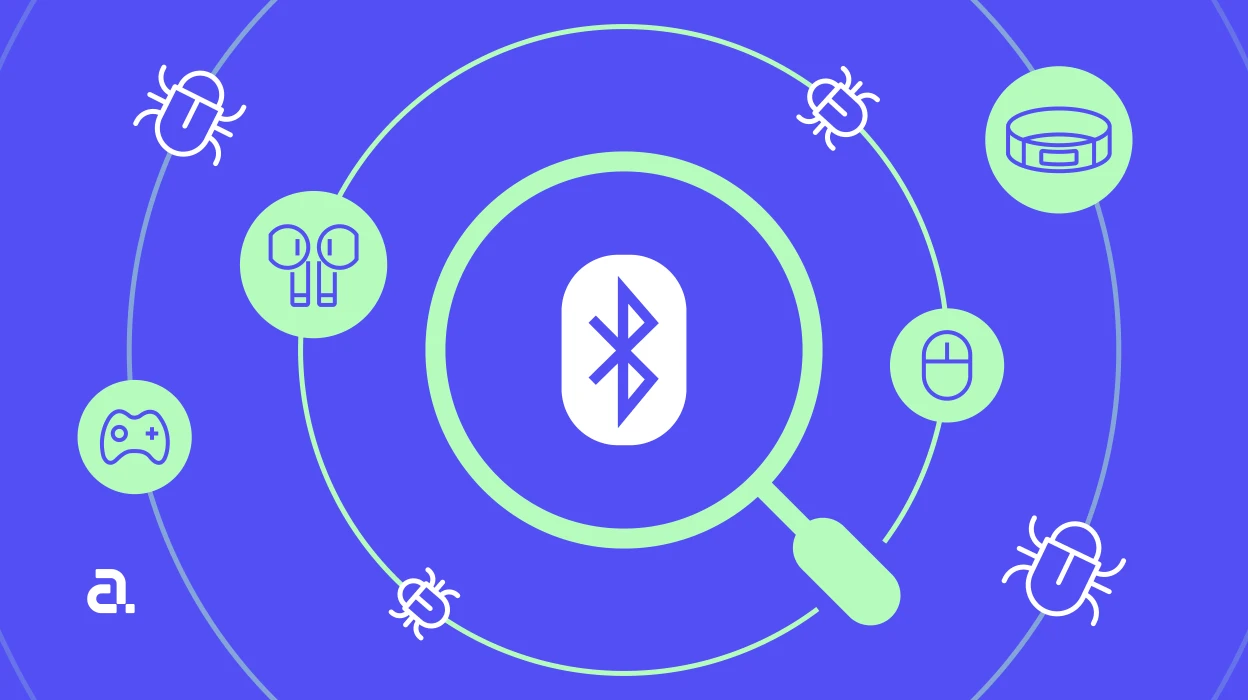

BLE failures directly impact user trust and retention
Bluetooth Low Energy (BLE) powers critical user experiences across fitness, healthcare, and connected consumer products. It enables continuous data exchange, seamless device pairing, and low-power communication that modern connected products depend on.
When BLE works, users rarely notice it. When it fails, it defines the entire experience.
The real-world impact shows up quickly. Users abandon devices that disconnect unpredictably. App store reviews frequently highlight “bluetooth not working” as a primary frustration. In health and fitness products, unreliable data breaks trust and reduces long-term engagement.
Most BLE devices pass QA. Yet they still fail in production.
The core issue lies in how teams validate BLE systems. Teams test BLE in controlled environments, while real-world reliability depends on variables that QA rarely captures. This gap creates systems that appear stable in the lab but degrade quickly in actual usage.
1. Lack of system-level design causes BLE failures
A reliable BLE connection depends on the entire system working in sync. Firmware, mobile application, operating system behavior, and environmental conditions all contribute to performance.
-2.webp)
Teams often optimize individual components instead of the full system.
In practice, teams frequently misinterpret firmware instability as app issues. This pattern shows up in several ways:
- Frequent connect and disconnect cycles
- Incorrect connection parameters
- Memory leaks or unexpected crashes
- Changing GATT structure during development
- Poor GATT design without versioning or with overloaded characteristics
These issues rarely exist in isolation. They emerge at the intersections between layers. One team owns firmware, another owns the app, and no single team owns the system-level behavior. This fragmentation makes it difficult to isolate root causes and extends debugging cycles.
A system-first approach changes how teams design and validate BLE. It encourages teams to define clear contracts between firmware and application layers, stabilize GATT structures early, and align connection strategies across platforms. Teams that adopt system thinking reduce integration issues significantly and improve long-term reliability.
2. Lab validation masks real-world variability and scale
QA environments create predictability. Teams test on a limited set of devices, operate in clean RF conditions, and run short sessions.
Real-world usage looks very different. For example, Ericsson’s Mobility Report highlights that device density and interference in urban environments continue to increase significantly, which directly impacts wireless performance and reliability at scale.
Users interact with BLE devices across a fragmented ecosystem of smartphones, operating systems, and hardware capabilities. Signal strength varies constantly due to physical obstacles such as walls and even the human body. Interference from Wi-Fi networks and nearby BLE devices introduces additional instability. Sessions last longer, and data loads increase as users rely on devices throughout the day.
It’s no surprise wireless interference remains one of the biggest challenges for BLE performance, as Bluetooth operates in the crowded 2.4 GHz spectrum alongside Wi-Fi and other devices, increasing the likelihood of packet collisions and data loss.
BLE performance depends on several external factors:
- Physical barriers that attenuate signals
- Competing wireless signals from Wi-Fi and other BLE devices
- Variations in smartphone hardware and antenna quality
- Concurrent connections and higher data throughput requirements
-3.webp)
Systems that perform well in controlled environments often fail under these conditions. Small-scale testing does not expose issues related to concurrency, sustained usage, or signal variability.
Teams need to expand validation beyond the lab. Real-world testing across multiple devices, environments, and usage patterns reveals issues early and reduces post-release failures. Subsequently, teams that simulate real-world conditions during validation achieve significantly higher stability in production.
3. Poor app architecture makes BLE systems hard to debug and scale
BLE communication introduces inherent complexity. It operates asynchronously, exchanges byte-level data, and relies on event-driven workflows.
Without a strong application architecture, this complexity becomes unmanageable. In fact, a Deloitte study on engineering maturity highlights that organizations with well-structured system architectures reduce debugging time and post-release defects by up to 30–40%.
Teams often embed BLE handling directly into application logic. This approach leads to tightly coupled systems where state management, data parsing, and connection handling intertwine. Debugging becomes difficult, and small issues cascade into larger failures.
Common problems include:
- Difficulty tracing data flow across asynchronous events
- Misinterpretation of byte streams
- Race conditions during connection and data exchange
- Inconsistent state management across app components
These issues limit scalability and reduce reliability under real-world conditions.
A structured architecture separates concerns clearly. Dedicated BLE layers handle connection management, data parsing, and state transitions; while higher-level application logic interacts with these layers through well-defined interfaces.
-4.webp)
Designing workflows around connectivity plays a critical role here. Teams need to define how the app behaves during connection loss, retries, and partial data availability. Users should experience predictable flows even when connectivity fluctuates. For example, a fitness app can cache data locally and sync when the connection stabilizes, instead of failing silently or showing inconsistent metrics.
Teams that design connectivity-aware workflows create resilient user experiences. They reduce perceived failures and improve overall product reliability.
4. Reconnection breaks in background and real-world app states
Real-world usage involves constant state changes. Users move out of range, switch between apps, lock screens, and expect devices to reconnect automatically when they return.
Reconnection often fails in these scenarios.
-5.webp)
Mobile operating systems impose strict limitations on background execution. Android restricts background processes, which often causes connections to drop unless the app uses foreground services. iOS supports limited BLE background modes with strict constraints on scanning and connection behavior.
Auto-connect behavior varies across devices and OS versions. Permission changes introduced in recent Android versions add further complexity.
These factors create inconsistent reconnection experiences:
- Connections drop when apps move to the background
- Auto-reconnect fails under certain OS conditions
- Permission changes interrupt expected workflows
- Device-specific behaviors introduce unpredictability
Teams often design reconnection flows for ideal scenarios. Real-world usage requires a different approach. When this kind of usage is addressed, the results are real. McKinsey research shows that improving reliability and reducing friction in digital experiences can increase user retention by 20–30%.
A reconnection-first design prioritizes resilience. It accounts for OS constraints, manages state transitions explicitly, and handles permission changes proactively. It also defines clear retry strategies and user feedback mechanisms.
Teams that invest in robust reconnection strategies reduce drop-offs significantly. A study by Google’s Android Developers team indicates that apps with optimized background handling and reconnection flows improve session continuity by over 25% in BLE-heavy use cases.
5. Data issues make bluetooth not working harder to diagnose
Connectivity represents only one part of the problem. Data reliability plays an equally important role.
Users often perceive data inconsistencies as connectivity failures. Even when a BLE connection exists, issues such as packet loss, duplication, or silent sync failures create the impression that the system does not work. The impact of these failures is very real. According to a study, 32% of customers will stop doing business with a brand they love after just one bad experience, making even intermittent data issues critical to address.
Common data-related challenges include:
- Dropped packets during transmission
- Duplicate data due to retry mechanisms
- Silent synchronization failures
- Inconsistent data interpretation across app and firmware
These issues complicate debugging. Engineers may focus on connection stability while the root cause lies in data handling. When done correctly, reliable systems treat data integrity as a first-class concern. They implement validation mechanisms, acknowledgments, and retry strategies at the protocol level. They also ensure consistent data parsing and error handling across layers.
Clear user feedback improves transparency. Users should understand when data sync fails and what actions they can take. This approach reduces frustration and builds trust, even when issues occur.
Reliability requires a structured approach, not isolated fixes
Reliable bluetooth low energy systems require a comprehensive strategy that spans the entire lifecycle.
Teams must validate across devices and operating system versions; and test in real-world environments that reflect actual usage patterns. They need to design systems with reconnection as a core principle rather than an afterthought. Alignment across firmware, application, and backend systems ensures consistent behavior. Continuous monitoring after release helps teams identify and address issues proactively.
Reliability does not come from isolated fixes. It emerges from a systematic approach that integrates design, development, testing, and monitoring.
See how we did this for Cubii, the world's first smart under-desk elliptical trainer.
BLE reliability is built across the entire system
BLE products do not fail due to limitations in the technology itself. Failures occur when teams treat reliability as a one-time validation step instead of an ongoing system-wide discipline.
Reliable BLE performance depends on multiple factors working together:
- Consistent connectivity across devices and operating systems
- Predictable reconnection behavior
- Reliable data transfer without loss or duplication
- Firmware that handles real-world usage conditions
- Clear error handling and user feedback
- Testing beyond controlled environments
- Ongoing monitoring in production
-6.webp)
Users experience all failures in the same way. They describe it as bluetooth not working.
Teams that approach BLE as a system rather than a feature build more resilient products. They reduce user frustration, improve retention, and create experiences that users can trust.
Reliable BLE performance requires an end-to-end approach. It requires teams to think beyond QA and design systems that perform under real-world conditions.
Build BLE systems that work in the real world beyond QA
Wondering where to start? We’ve got you covered.
Check out the the complete BLE validation checklist to:
- Cover real-world edge cases
- Validate across devices, operating systems, and environments
- Ensure your BLE system performs reliably at scale
Build BLE systems that work where it matters most: in the real world.
Download the BLE validation checklist for free!


Authors

Harsh Soni

More ways to listen


Podcast Transcript