
A CFO and a CIO are reviewing a proposal for an AI agent that will process insurance claims.
CFO: What will this cost us to run?
CIO: About $3 per million input tokens and $15 per million output tokens.
CFO: Okay. What does that mean for next year’s budget?
Both people are being reasonable. The CIO gave an accurate answer to a technical question. The CFO asked a business question, and a token rate can’t answer it alone.
Here’s the short answer this article builds toward: budget an AI agent by what it costs to complete one unit of business work, such as one claim processed or one ticket resolved, then multiply by the volume you expect. The price of AI tokens is one input to that number. It’s rarely where the budget surprises come from.
These surprises are common. Gartner expects more than 40% of agentic AI projects to be canceled by the end of 2027, with escalating costs among the top reasons. In a 2026 survey of 396 enterprises, only 11% said they could predict AI costs within 10% of actual spend. Nearly two-thirds said unexpected AI costs had materially affected business decisions in the past year.
Below is the framework we use to turn a token rate into a budget a finance team can work with. One example runs through the whole article: an AI agent that processes insurance claims.
The 8 factors that shape an AI budget beyond AI tokens
Why AI token pricing doesn’t tell you what an AI agent will cost
Token pricing tells you the cost of one model call. An AI agent makes several calls to finish one task, so the real cost per task is a multiple of what a single call suggests.
A token is a small chunk of text, roughly three-quarters of a word. Vendors price models per million tokens. They charge one rate for what goes in (instructions, documents, context) and a higher rate for what comes out (the model’s response).
That pricing maps neatly onto a chatbot answering one question. A single request to an AI agent can trigger a chain of work behind the scenes:
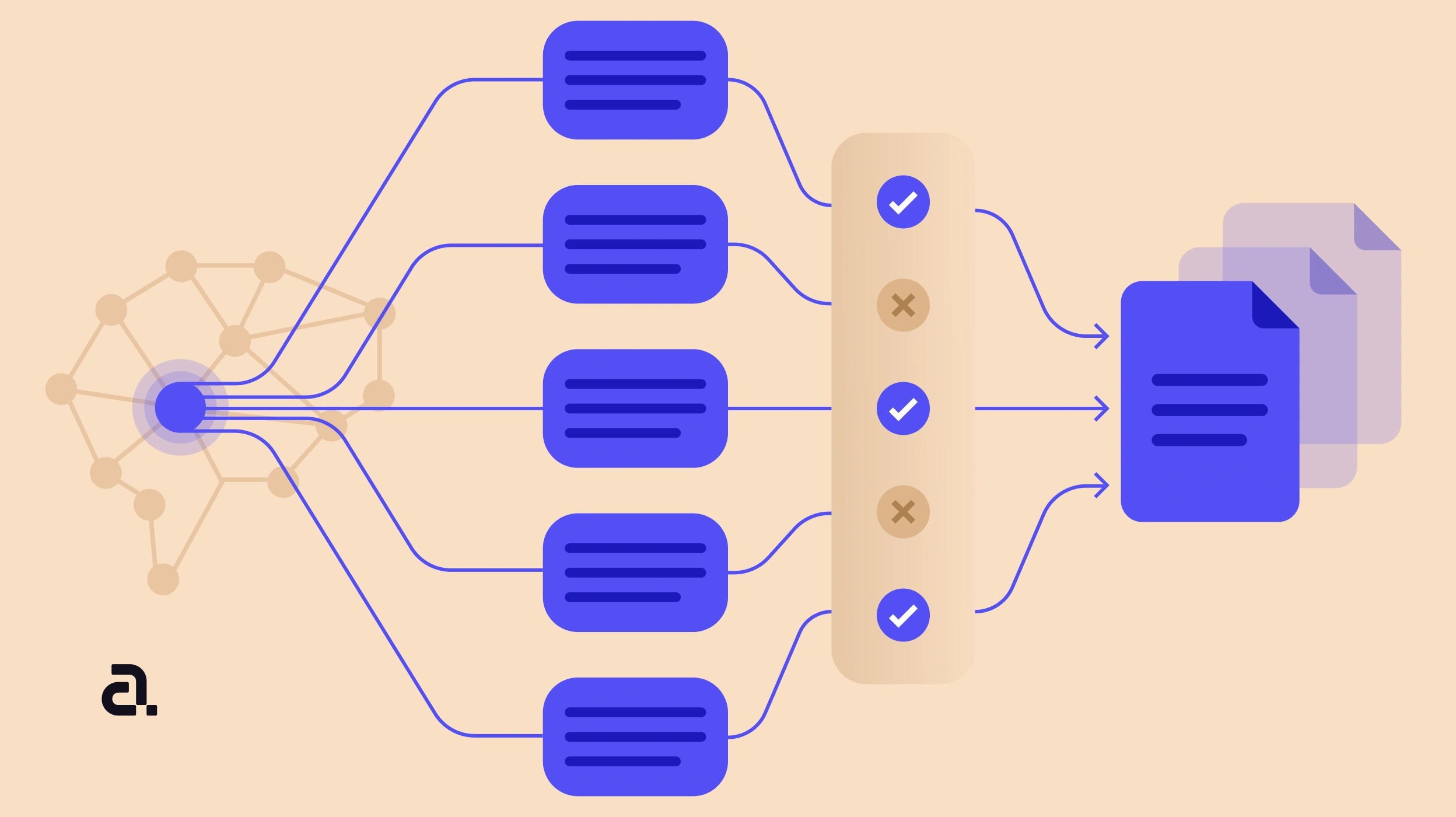
User request → plan → model call → tool lookup → model call → verification → retry if needed → completed task
Every step consumes tokens. Anthropic’s engineering team reported that agents typically use about 4× more tokens than chat interactions, and multi-agent systems about 15× more. One request is rarely one model call.
What business unit are you paying the AI to deliver?
The business unit is one completed outcome that your operations team already counts, such as one claim processed. Every other number in the budget hangs off it.
Agree on it before anyone opens a pricing page. Depending on the workflow, it might be:
- One insurance claim processed
- One customer inquiry resolved
- One invoice matched and approved
- One loan application reviewed
- One document classified
A good business unit has five properties:
- It represents a finished outcome rather than an intermediate step
- It’s measurable from systems you already run
- It moves in step with business volume
- It stays meaningful when demand rises or falls
- It captures all the work the AI agent performs
“Model calls per month” fails this test. Finance can’t plan against it, and it changes every time engineering adjusts the workflow. “Claims processed per month” passes, and your operations team already forecasts it.
How to calculate the cost of an AI agent per task
Cost per completed task is the model usage across every step, plus retries and verification, plus a share of infrastructure. Here are the six steps, applied to the claims agent.
- Define the completed task. One claim moved from intake to an adjuster-ready summary.
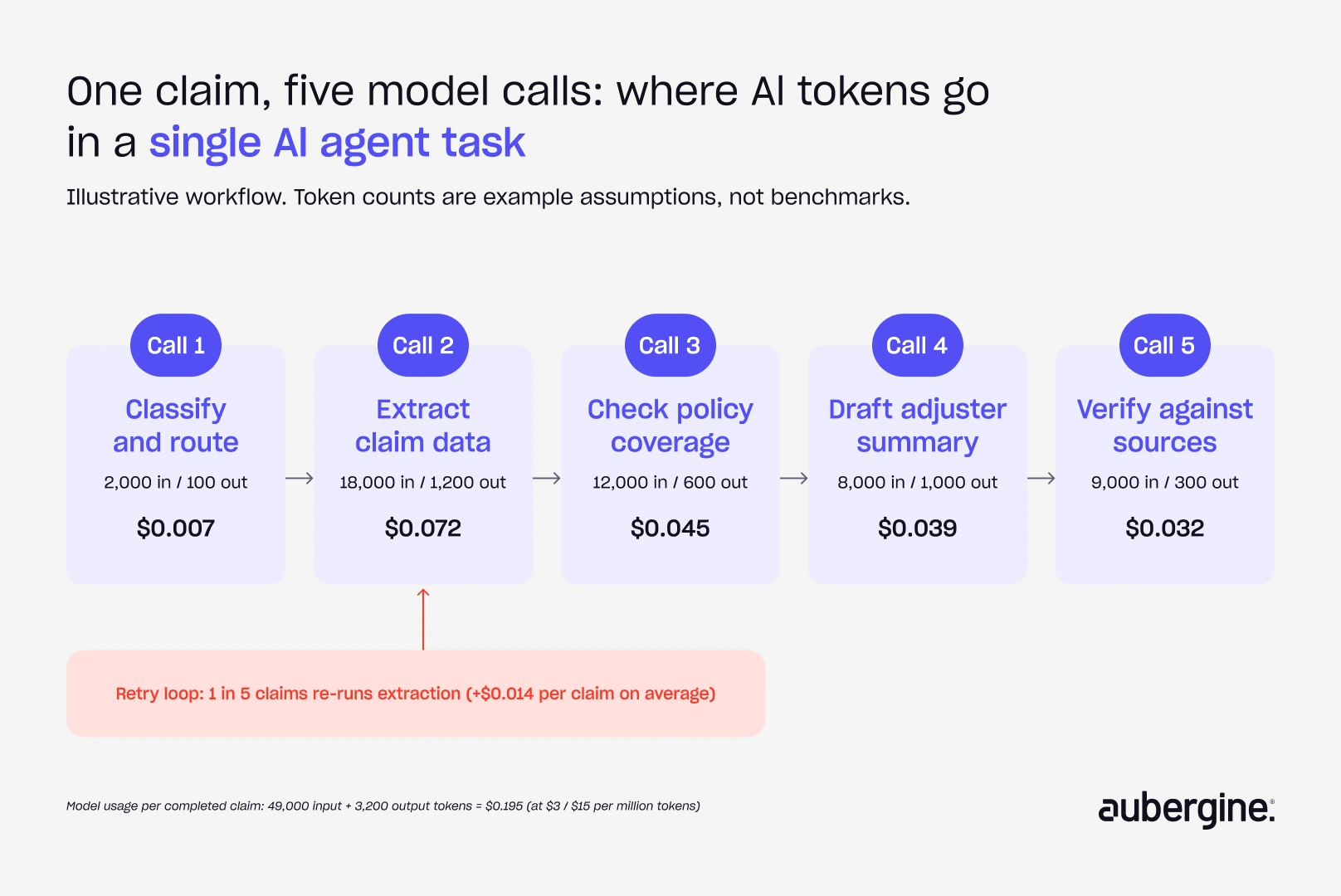
- Count the model interactions. The agent makes five calls: classify, extract data, check policy coverage, draft a summary, and verify the summary against sources.
- Add up input and output tokens. Across all five calls: 49,000 input tokens and 3,200 output tokens.
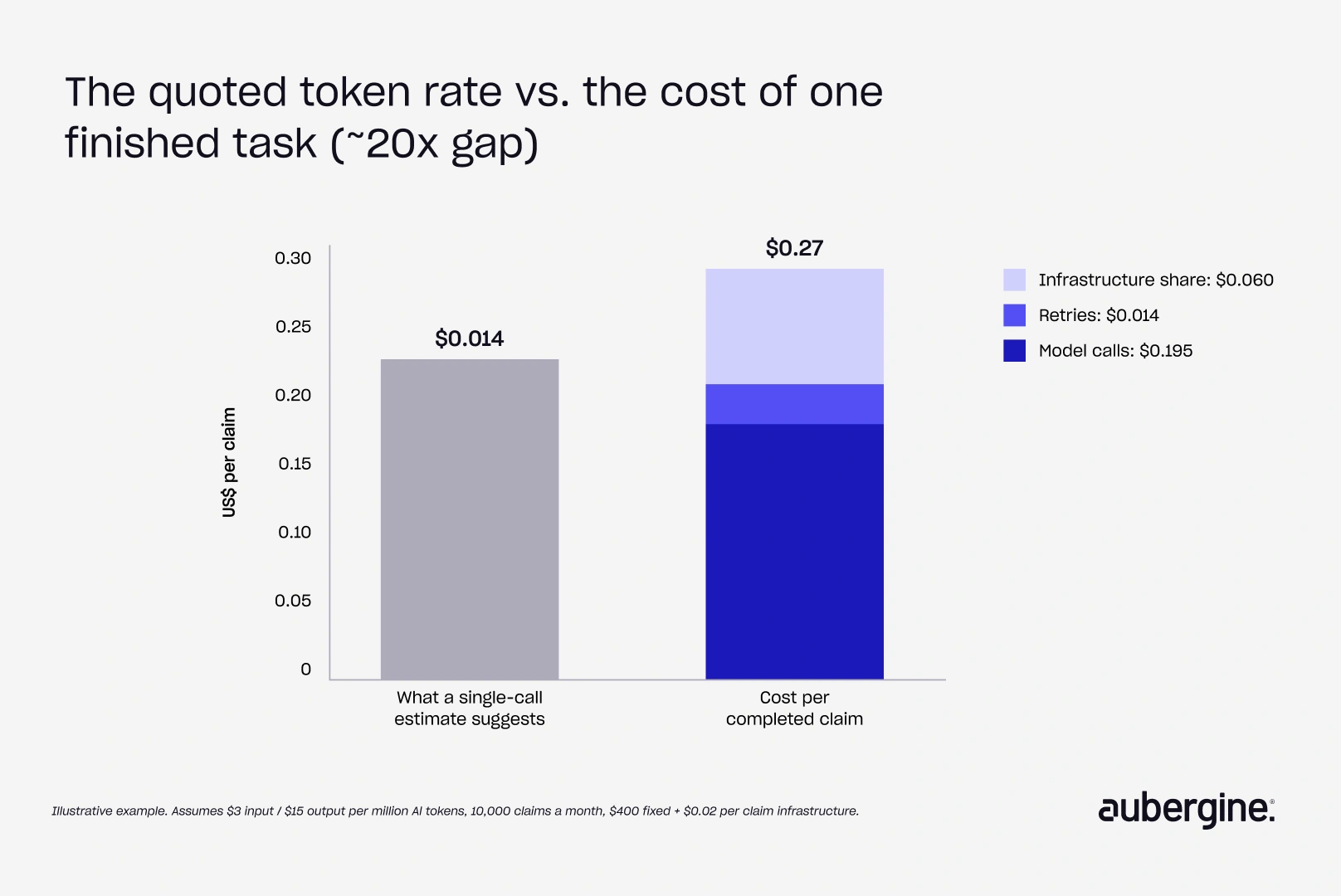
- Add retries, verification, and evaluation. Verification is already call five. Extraction re-runs on one claim in five, adding about $0.014 per claim on average.
- Add infrastructure. Document storage, retrieval, logging, and hosting come to roughly $0.06 per claim at 10,000 claims a month.
- Calculate the cost of one completed task.
At illustrative rates of $3 per million input tokens and $15 per million output tokens (as of October 2026):
A quick single-call estimate (2,000 tokens in, 500 out) would put the same claim at about $0.014. The real figure is roughly 20× higher, and the token rate didn’t change at all. Every extra cent comes from the workflow.
Use this worksheet to run the same calculation on your workflow:
Aim for a defensible number your finance team can question and refine. Precision can wait until production data arrives.
Is the AI agent cheaper than doing the task by hand?
Compare the AI cost per task with today’s fully loaded manual cost per task, and include the human review the AI still needs. The token bill is usually the smallest line in that comparison.
One industry estimate puts manual handling at $7 to $15 per claim document, or up to $375 per claim before an adjuster makes a coverage decision. Your number will differ, so pull it from your own operations data.
Human review time will likely outweigh the model cost. At an illustrative $48 an hour fully loaded, a five-minute review adds $4.00 per claim, roughly 15× the AI’s own cost. Cutting review time matters more to the business case than squeezing token spend. Our guide on how to measure AI ROI walks through tying this comparison to business outcomes.
How to turn AI cost-per-task into an annual budget
Multiply cost per completed task by expected monthly volume, then by 12. Run the math at several volumes so finance sees a range rather than a single point.
Cost per completed task × expected task volume = estimated AI operating cost
A COO or CFO can drop this straight into an operating plan. This table assumes the cost per claim stays flat. In practice it moves, which the next sections cover.
What changes AI agent cost over time, and where AI cost optimization fits
Cost per task is a live metric. It shifts whenever the system shifts. Common causes:
- The team switches models, or the provider changes its pricing
- The workflow gains steps, such as an added compliance check
- Retry rates climb as messier inputs arrive
- Extra verification or human review is added for high-risk cases
- Volume changes, spreading fixed infrastructure costs thinner or wider
- Infrastructure moves between providers, or from hosted to self-hosted
Some of these push the number down. Token prices have fallen fast: Epoch AI found the price of reaching a given level of model performance dropping between 9× and 900× per year depending on the task, with a median of 50×. Product changes usually push it back up, as teams add steps to handle edge cases.
This is where AI cost optimization earns its place. The levers we reach for most often:
In the claims example, extraction accounts for 37% of model cost. That’s where we’d look first.
What’s included in the total cost of ownership of an AI agent?
Total cost of ownership covers everything needed to run the agent safely at scale: model usage, infrastructure, and the people and processes around them. In enterprises, the lines outside the model often add up to more than the token bill.
Deployment choice also moves the number. An open-source model can look cheaper per token while needing serious infrastructure and people to run it. A hosted model avoids that upfront investment and converts everything into usage-based spend.
Our default: start hosted, measure real volume, and revisit once usage is steady enough to make utilization predictable. We cover the broader version of this decision in build or integrate: how to approach AI in product building.
How much should you budget for an AI pilot?
Budget more than “production tasks × cost per task.” A pilot spends money before it completes a single production task, as teams test prompts, compare models, score outputs, and re-run the same test set dozens of times.
- Production usage: Real tasks processed during the pilot
- Testing: Prompt and workflow iterations
- Evaluation: Running test datasets and scoring outputs
- Experimentation: Trying alternative models and approaches
- Infrastructure: Environments, storage, and logging
Evaluation deserves its own line. Each prompt change triggers a full re-run of the test set, which is how the team confirms nothing broke. Skipping that discipline is one of the patterns we describe in why AI agents fail. Fund it from day one.
How do AI costs scale as volume grows?
Unit cost usually falls as fixed costs spread, while total cost swings with workflow complexity and token prices. A useful scenario model treats each of these as an adjustable input. Here’s the claims example with $400 a month of fixed infrastructure spreading across more claims.
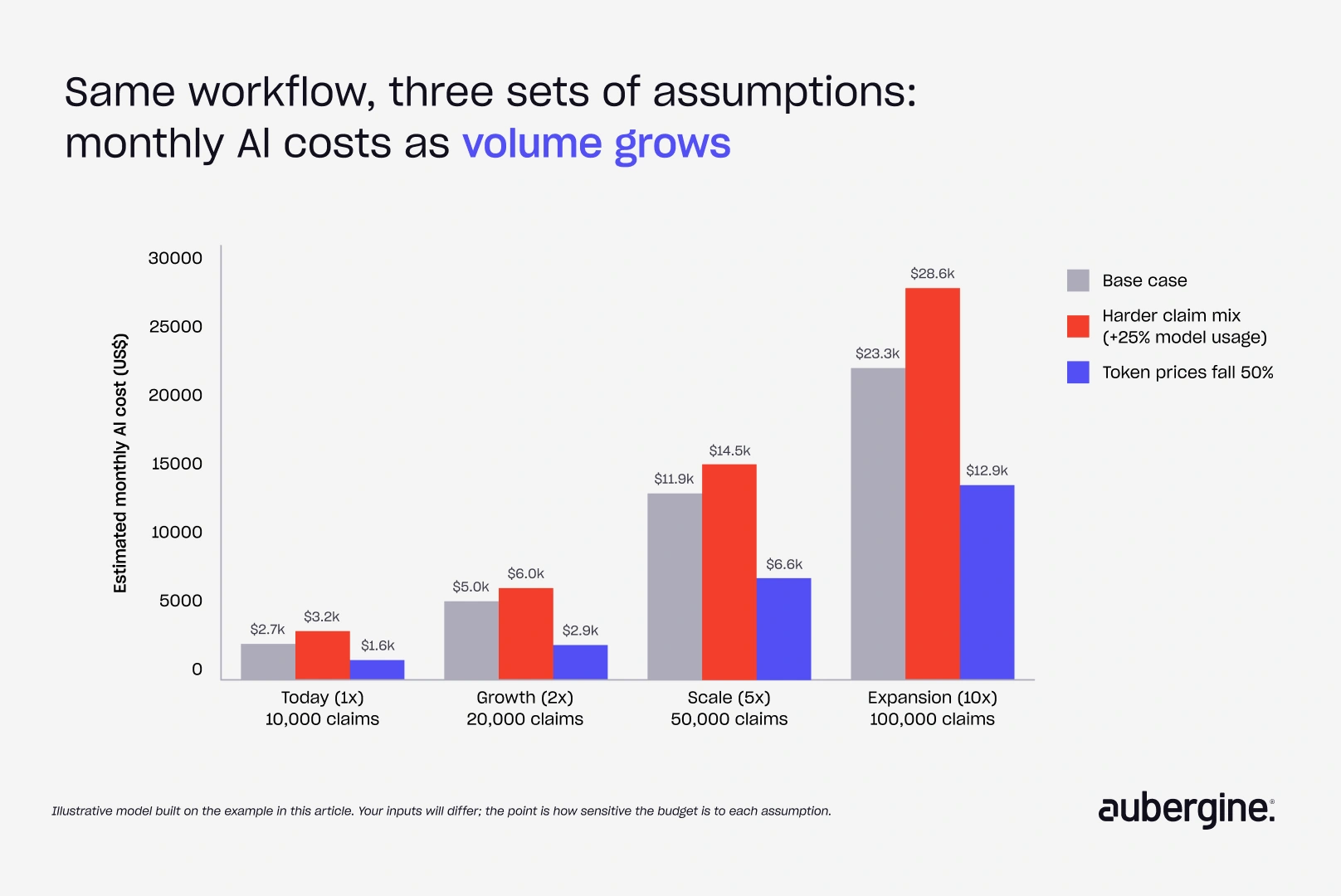
Three things stand out:
- Spreading fixed costs lowers the unit cost by about 13% at 10× volume, so the flat-rate table overstated the budget by roughly $3,700 a month.
- A harder claim mix at 10× volume adds about $5,300 a month over the base case.
- A 50% drop in token prices moves the budget more than any operational change in the table.
The last point is why we treat token price as a range in every model we build. A budget that only works at today’s price will be wrong in one direction or the other within a year.
How to compare AI costs across a portfolio of pilots
Use cost per completed task as the common unit for every use case. It turns a set of unrelated pilots into numbers a leadership team can rank.
- Compare use cases: a claims agent, a support agent, and an invoice-matching agent all report cost per task against value per task.
- Decide what goes to production: pilots where value per task clearly beats cost per task, including review time, move forward first.
- Allocate costs across business units: tag every model call to a task and a team, then run showback or chargeback from the same data.
With only 11% of enterprises predicting AI costs within 10% of actual spend, one shared unit is the simplest fix available.
Questions to ask an AI vendor about AI agent cost
Bring these to your next proposal review, whether the proposal comes from us or anyone else.
About the workflow
- What exactly counts as one completed task?
- How many model calls does one task typically trigger?
- Which steps can retry, and how often?
About cost
- What is the current cost per completed task, and does it include retries and evaluation?
- Which model and infrastructure costs are included, and which are left out?
- What assumptions sit behind the estimate?
About scale and infrastructure
- What happens to cost at 2×, 5×, and 10× volume, and why?
- Are we using a hosted model or self-hosting?
- Would a different deployment model change the unit economics?
A vendor who answers these clearly has modeled your workflow. A vendor who keeps returning to the token rate probably hasn’t yet.
An AI budgeting worksheet for your first planning meeting
Most of the numbers in an AI budget sit with different people. Operations knows the volume, engineering knows the tokens per task, and finance owns the projections. Use this table as the agenda, with the claims example as a model answer.
What this means for your AI pilot
An AI pilot doesn’t need a perfectly predictable cost model. It needs enough visibility to understand the economics of the work. Three questions get you there:
- What does one completed task cost?
- What happens when task volume grows?
- Which assumptions could change the number?
The token rate still feeds the answer. The budget conversation belongs to the finished task. If you remember one line from this article, make it this one: price the claim, not the token.
Planning your first AI pilot?
Our AI Opportunity Audit maps the workflow, defines the right business unit, and builds a cost-per-task model before you commit to implementation. You leave with a budget your finance team can stress-test and a clear view of where AI pays for itself. Let’s talk.
FAQs
How many tokens does an AI agent use to complete one task?

It varies widely with the workflow. A simple classification step might use a few thousand tokens. A document-heavy task that reads contracts or claim files can use tens of thousands per run. The reliable way to find out is to log token usage per task during the pilot, then use the median and the 90th percentile in your budget.
Why are output tokens more expensive than input tokens?
Models generate output one token at a time, which takes more compute than reading input. Output is often priced three to five times higher than input. That’s why long, verbose responses cost more than they seem to, and why structured, concise outputs help keep costs down.
Is running an open-source model cheaper than paying for API tokens?
Sometimes, at high and steady volume. You pay for GPUs, hosting, and engineering time whether the model is busy or idle. If your usage is uneven or still growing, a hosted API is usually cheaper until volume becomes predictable.
Should we wait for token prices to drop before starting an AI pilot?
Usually not. Prices have been falling quickly, and a pilot built today benefits from future price cuts automatically. Waiting delays what you learn about your workflow, data, and business unit, which is the part that takes the longest.
Who should own AI costs: IT or finance?
Both, with a shared metric. Engineering controls the levers (models, prompts, retries), and finance owns the budget. Cost per completed task gives both teams one number to track, which makes the monthly review far less contentious.
How do we track cost per task once the AI agent is live?
Tag every model call with the task it belongs to, then roll up tokens, retries, and infrastructure by task. A dashboard showing cost per resolved claim or ticket, updated daily, catches drift before it reaches the monthly bill.
Does a fixed-price vendor contract remove the cost risk?
It shifts the risk to the vendor, and you pay for that. The vendor builds a margin for uncertainty into the fixed price, so you may pay more than actual usage would cost. Ask how the price was derived, and what happens if your volume or task mix changes.
How do large enterprises govern AI costs across business units?
Most set budgets per business unit and per use case, enforced through tags on every model call. A central platform team usually owns the provider agreement, routing rules, and spend alerts. Each business unit owns its volume forecast. Automated alerts fire before a budget is exceeded, rather than after the invoice arrives.
How much does an AI agent cost in year one, beyond usage?
In year one, build and integration work, evaluation setup, security review, and reviewer training usually cost more than tokens. Usage grows as volume ramps up. Track one-time costs separately from run costs, so the ongoing run rate your finance team plans against isn’t inflated by setup spend.


Authors

Sarthak Dudhara

More ways to listen


Podcast Transcript