
Artificial intelligence has changed the way software is built, but the conversations that start AI initiatives haven't changed all that much.
Product teams still begin with business objectives such as:
- Automate a manual process
- Improve an existing digital workflow
- Reduce the time employees spend searching for information
- Make customer support more efficient
Once these objectives are clear, the next question inevitably follows:
Should we build these AI capabilities ourselves or integrate what's already available?
At first glance, this sounds like an engineering decision. In reality, it's also a business decision with technical implications.
Every AI capability carries trade-offs across engineering investment, infrastructure ownership, operational complexity, speed to market, and long-term maintenance. While building proprietary AI can create lasting competitive advantage, rebuilding capabilities that already exist often delays delivery without adding customer value.
The most successful AI products don't begin with architecture diagrams or model comparisons. They begin with a much simpler question:
What business outcome are we trying to achieve?
Once that objective is clear, the decision to build, buy, or integrate becomes significantly easier.
Start with the outcome, not the architecture
Many AI discussions begin with technical questions.
- "Should we use OpenAI or Anthropic?"
- "Should we build our own AI system?"
- "Can we train our own model?"
These questions matter, but they're rarely the best place to start.
Instead, product teams should begin by clearly articulating the problem they're trying to solve. AI can support very different objectives, and each one naturally leads to different implementation decisions.
For example:
Notice how the discussion starts with the objective rather than the technology.
Many organisations assume AI is the answer because it feels like the obvious next step. In practice, many problems are process problems disguised as AI problems.
When the right answer wasn't AI: A Case study
SPE Automation (anonymized), a Hyderabad-based industrial maintenance company with over US$60 million in annual revenue, wanted to introduce AI across its maintenance and operations platform to improve operational efficiency.
They approached us to identify where AI could create meaningful business value across their platform, and whether building AI capabilities was the right investment.
The initial assumption was straightforward: AI agents could automate multiple maintenance and operations workflows.
What we evaluated
- Existing user journeys
- Operational workflows
- Manual decision points
- Data availability and quality
- Opportunities for AI-assisted recommendations
What we discovered
- Several proposed "AI features" were actually workflow bottlenecks.
- Process redesign eliminated unnecessary manual effort.
- Some problems required better product design rather than machine intelligence.
- Only a subset of use cases genuinely benefited from AI-assisted recommendations and document analysis.
Instead of introducing AI everywhere, the project focused on the areas where AI created measurable operational value.
This illustrates an important principle: The first decision is whether AI creates enough value to justify building anything at all.
Build what makes you different
Once the objective is clear, the next question becomes much simpler.
What should we actually own?
This is where experienced product teams separate themselves from everyone else. Rather than building every capability in-house, they focus engineering investment on the parts of the product competitors can't easily replicate.
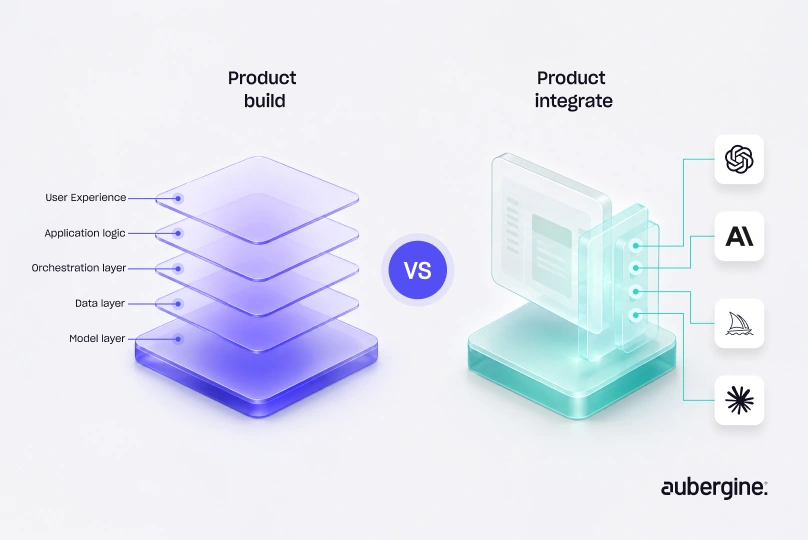
Build these:
Engineering effort is usually best spent on capabilities that encode your business expertise.
- Proprietary business logic
- Customer-specific workflows
- Domain expertise
- Internal knowledge bases
- Decision engines
- Product experience
- Evaluation pipelines
- Guardrails and business rules
Integrate these
Many AI capabilities have become mature infrastructure rather than competitive differentiators.
- Foundation models
- Speech recognition
- Text-to-speech
- OCR
- Translation
- Authentication
- Messaging
- Embedding services
Infrastructure can usually be purchased. Differentiation cannot.
A useful rule of thumb
In these cases, the competitive advantage comes from orchestrating technologies to solve a business problem better than anyone else, not building what already exists.
Think in layers, not features
One of the biggest mindset shifts with modern AI products is recognising that they're built from multiple specialised layers.
An AI feature may look like a single capability to the user, but that's rarely how it's built. Most AI products combine multiple specialised components, each serving a different purpose and requiring a different build-versus-integrate decision.
Behind the scenes, the application may combine:
- An LLM
- A retrieval pipeline
- Tool calling
- Internal APIs
- Business rules
- Evaluation layers
- Customer data
- Human approval workflows
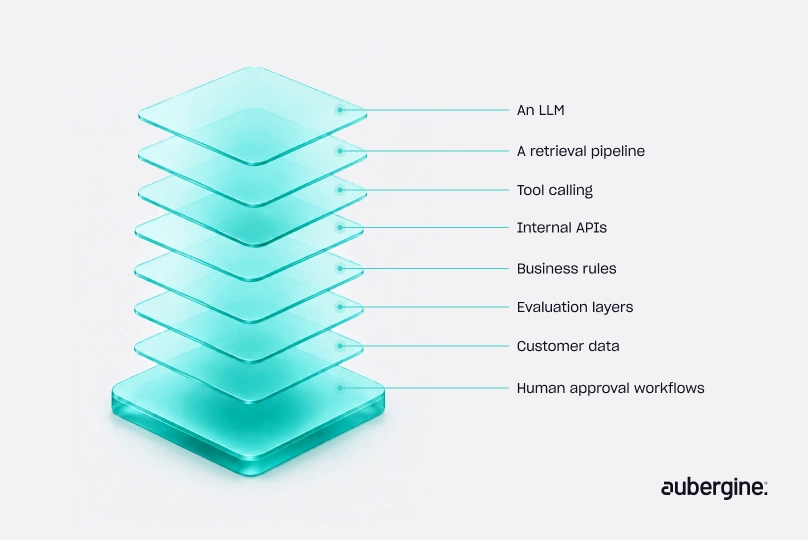
Engineering effort creates long-term value in these orchestration and business layers, not necessarily in the underlying model itself.
A simple engineering test
Before building an AI capability, ask these questions.
Integration isn't about taking shortcuts
One misconception that often appears in AI discussions is that integrating third-party services somehow represents weaker engineering.
In reality, experienced product teams often integrate first because it's the fastest way to validate customer demand and reduce delivery risk.
Using mature AI platforms allows teams to:
- Reach the market faster
- Experiment with product ideas
- Validate customer behaviour
- Reduce infrastructure ownership
- Focus engineering effort on differentiated capabilities
This approach is particularly valuable during early product development, where learning speed often matters more than architectural purity.
Integration turns a three-month AI project into a three-week release: A case study
Foundry AI (anonymized), an HR technology company based in Ahmedabad, India, that helps automate employee lifecycle processes using conversational AI, is a case in point. The company wanted to automate employee exit interviews while improving consistency and reducing manual effort.
Rather than investing months building voice infrastructure from scratch, the solution integrated an existing voice AI SDK and focused engineering effort on the business problem.
Instead of building
- Speech recognition
- Audio streaming
- Voice synthesis
- Real-time conversation infrastructure
- Low-latency voice processing
Engineering focused on
- Interview logic
- HR-specific business rules
- Conversation design
- Evaluation workflows
- Analytics and reporting
- Enterprise integrations
The AI solution reduced resume review time from 10–15 minutes to 2–5 minutes and automated routine exit interviews, enabling HR teams to focus only on cases that require deeper follow-up. The business stakeholders never cared whether the speech engine was proprietary. They cared that the interview experience was natural, reliable, and useful. This is the distinction that really mattered.
Build later, if the business earns it
One of the biggest mistakes in AI product development is treating architectural decisions as permanent. They aren't.
An integration that makes perfect sense for an MVP may become expensive or limiting as the product grows. Conversely, building proprietary infrastructure too early can delay learning without creating any meaningful customer value.
For early-stage products, the priorities are usually clear: validate demand, shorten time to market, and learn from real users. Integrating existing AI capabilities allows teams to focus on refining the product instead of maintaining infrastructure.
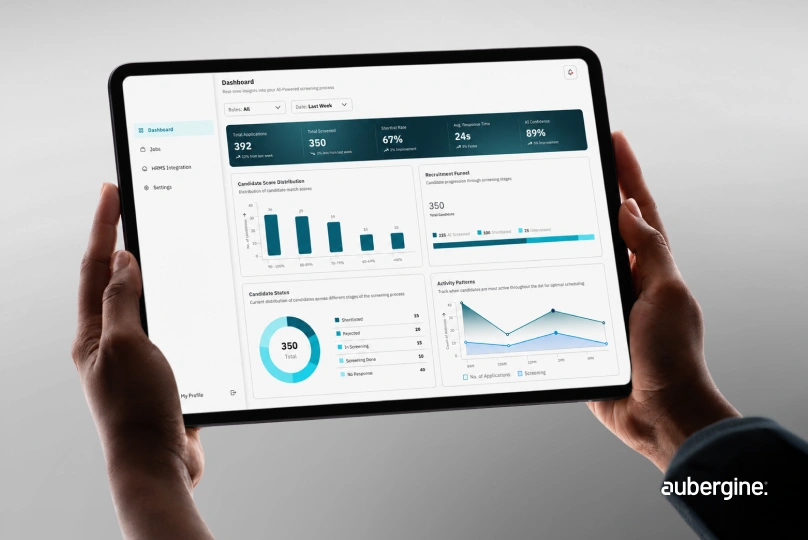
Reference image (indicative dashboard that shows performance measurement)
A proof of concept is often the most effective way to make this decision. Rather than debating whether to build or integrate, launch a small implementation and measure what matters:
As products mature, these answers begin to change.
Growing API bills, stricter latency requirements, increasing traffic, or the need for deeper customisation may justify bringing specific capabilities in-house. At that point, the decision is no longer driven by curiosity or technical ambition. It's driven by business value.
Think in systems, not components
One reason the build-versus-integrate debate often feels unproductive is because modern AI systems rarely fit neatly into either category.
Most successful AI products are hybrids.
A customer interacting with an AI feature may assume it's powered by a single model, but behind the scenes several layers work together. A foundation model generates responses, a retrieval layer supplies business context, orchestration determines which tools to call, proprietary business logic validates outputs, and customer data personalises the final experience.
Each layer serves a different purpose.
Some are commodity capabilities that can be integrated. Others represent the unique expertise the business has spent years developing. That's where engineering effort creates lasting value.
This systems-approach also provides flexibility. As AI technology evolves, individual components can be replaced without redesigning the entire product. Foundation models improve, infrastructure providers change, and new services emerge, but the proprietary layer that differentiates the product remains under your control. The real competitive edge today involves choosing a better model, sure, but designing a better system is where the real wedge is.
A practical framework for AI build vs. integrate decisions
There's no universal answer to the build-versus-integrate question, but there is a practical way to approach it.
Rather than starting with technology, work through a series of product decisions.
- Define the objective. Are you automating a manual process, improving an existing workflow, or creating a completely new capability?
- Decide whether AI is necessary. Not every problem requires an AI solution. AI solutions are expensive to run and maintain and expenses scale linearly with usage as opposed to traditional SaaS.
- Identify where differentiation lives. Invest engineering effort in capabilities competitors can't easily replicate.
- Integrate commodity services first. Use existing infrastructure to validate ideas quickly and reduce development risk.
- Measure before rebuilding. Let customer behaviour, operational costs, and business outcomes determine whether internal ownership makes sense.
- Revisit the decision as you scale. What should be integrated today may be worth building tomorrow.
This framework encourages product teams to treat architecture as an evolving business decision rather than a one-time engineering choice.
Still not sure whether to build or integrate?
Download the AI Investment Checklist and work through 20 practical questions that help you make the right decision before writing a single line of code.
Conclusion
As AI capabilities continue to mature, more infrastructure will become commoditised. Foundation models, speech services, and other building blocks will become easier to access, making it increasingly difficult to compete on technology alone.
This shifts the focus back to what truly differentiates a product: proprietary workflows, domain expertise, customer context, and the unique ways those capabilities come together to solve real problems.
Successful AI product development today is all about making deliberate decisions about where engineering effort creates lasting value and where existing services can accelerate progress.
As you evaluate whether to build or integrate AI, it's equally important to identify where AI can create meaningful value in the first place. Make sure you also read our guide on how to Identify and Build AI That Matters, where we explore how product teams uncover high-impact AI opportunities by analysing user friction, workflows, and business outcomes.
Building an AI product or evaluating where AI fits into your existing one? Let's talk. We help product teams identify high-impact AI opportunities, make the right build-versus-integrate decisions, and deliver AI products that create measurable business value.
FAQs
When does it make sense to build AI instead of using APIs?

Building AI makes sense when the capability relies on proprietary business logic, domain expertise, customer-specific workflows, or unique data that competitors can't easily replicate. These are the areas where engineering effort creates long-term differentiation.
Is integrating AI just taking a shortcut?
No. Integrating mature AI services is often the fastest way to validate customer demand, reduce engineering effort, and reach the market sooner. It allows teams to focus on solving the business problem instead of rebuilding existing infrastructure.
How do I know if my product actually needs AI?
Start with the business outcome rather than the technology. Evaluate user journeys, operational workflows, manual decision points, and data quality before deciding whether AI is the right solution. In many cases, process improvements or better product design deliver more value than AI alone.
Can I switch from integrating AI to building it later?
Yes. Many successful AI products begin by integrating existing services to validate demand and accelerate delivery. As the product matures, customer adoption, operating costs, and business value can justify bringing specific capabilities in-house.
Will using the same AI models as everyone else make my product less competitive?
Not necessarily. Competitive advantage rarely comes from the foundation model itself. It comes from the business logic, workflows, proprietary data, and product experience you build around it.
How can I reduce the risk of investing in the wrong AI solution?
Instead of committing to a large implementation upfront, build a focused proof of concept. Measure adoption, business impact, operating cost, and accuracy before deciding whether deeper investment or ownership is justified.
Do I need to train my own AI model to build an AI product?
Usually not. Most successful AI products combine existing foundation models with proprietary business logic, retrieval systems, workflows, and company knowledge. Training a custom model is only necessary when existing models can't meet your performance or business requirements.


Authors

Aaditya Brahmbhatt

More ways to listen


Podcast Transcript