
If you're choosing an AI product development company, a convincing demo is a starting point, not a reason to sign. Ask the partner to show how its approach performs on representative cases from your workflow, how failures are handled, and who will maintain the system after launch. Then ask what it would advise you not to build.
I say this from the other side of the table. Our team offers AI product development services, and I know how much effort goes into earning a buyer's confidence. A referral opens the conversation. Relevant logos help. A demo can make an idea feel real. None of those, though, tells you enough about what will happen when the project becomes difficult, or whether the investment makes sense in the first place.
The question I hear underneath many buying conversations is not simply "Can you build it?" It is "What happens to us if this goes wrong?" Your evaluation should give you a better answer than a polished slide deck.
The question that changed a banking pitch
In one enterprise banking conversation, our early momentum slowed when a decision-maker asked for a live production deployment in their region. We had banking work in that region that was receiving positive client feedback, but it was not yet publicly live. That distinction mattered, and we could not present the project as something it wasn't.
Instead, we discussed what we could show: banking experience from other markets, what we had learned about localization and user behavior, and how we would apply that thinking to a digital roadmap for their platform. Adjacent experience was relevant, but it was not the same as a live local reference.
I understood why the buyer asked. Banking requirements and customer expectations are not interchangeable across markets. A partner should be able to explain where the similarities hold, where local knowledge is needed and how it will validate the gaps. A buyer should not be asked to simply take transferable experience on faith.
Domain experience matters. So does the ability to solve a new problem.
We once worked with an IoT startup that had spent two months struggling with an architecture issue. Our team resolved the bottleneck in a day and a half. That initial work became a longer partnership involving multiple teams.
This was an architecture problem, not an AI-agent case study. I would not use it as proof that every AI project can be solved in a day and a half. What it does show is that a team's ability to diagnose an unfamiliar technical problem can matter as much as whether it has built for your exact niche before.
When a partner has direct domain experience, ask what they personally delivered and what is actually in production. When their experience is adjacent, ask them to explain the transfer: which parts of their previous work are relevant, which are not, and what they need to learn. In both cases, talk to the people who would do the work, not only the people selling it.
Three questions to ask before choosing an AI development partner
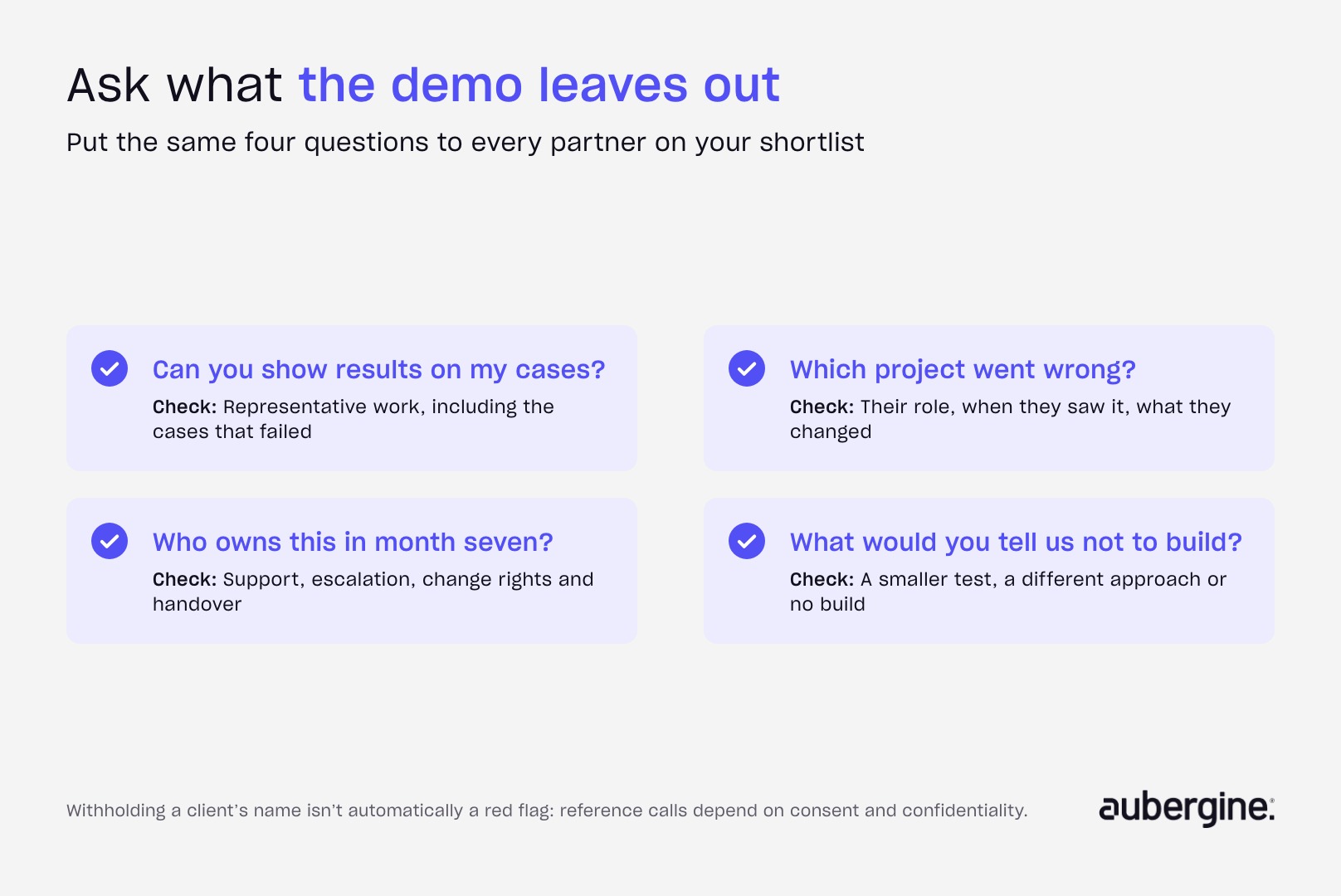
We've published a fuller set of questions to ask an AI agent vendor. From a buying perspective, I would focus the conversation on three questions that reveal what the demo leaves out.
1. Can you show me the results on cases that represent my work, including the failures?
A demo usually shows the path its creators prepared. That is useful for understanding the idea. It does not tell you how the proposed system behaves with the documents, questions and exceptions your team will actually encounter.
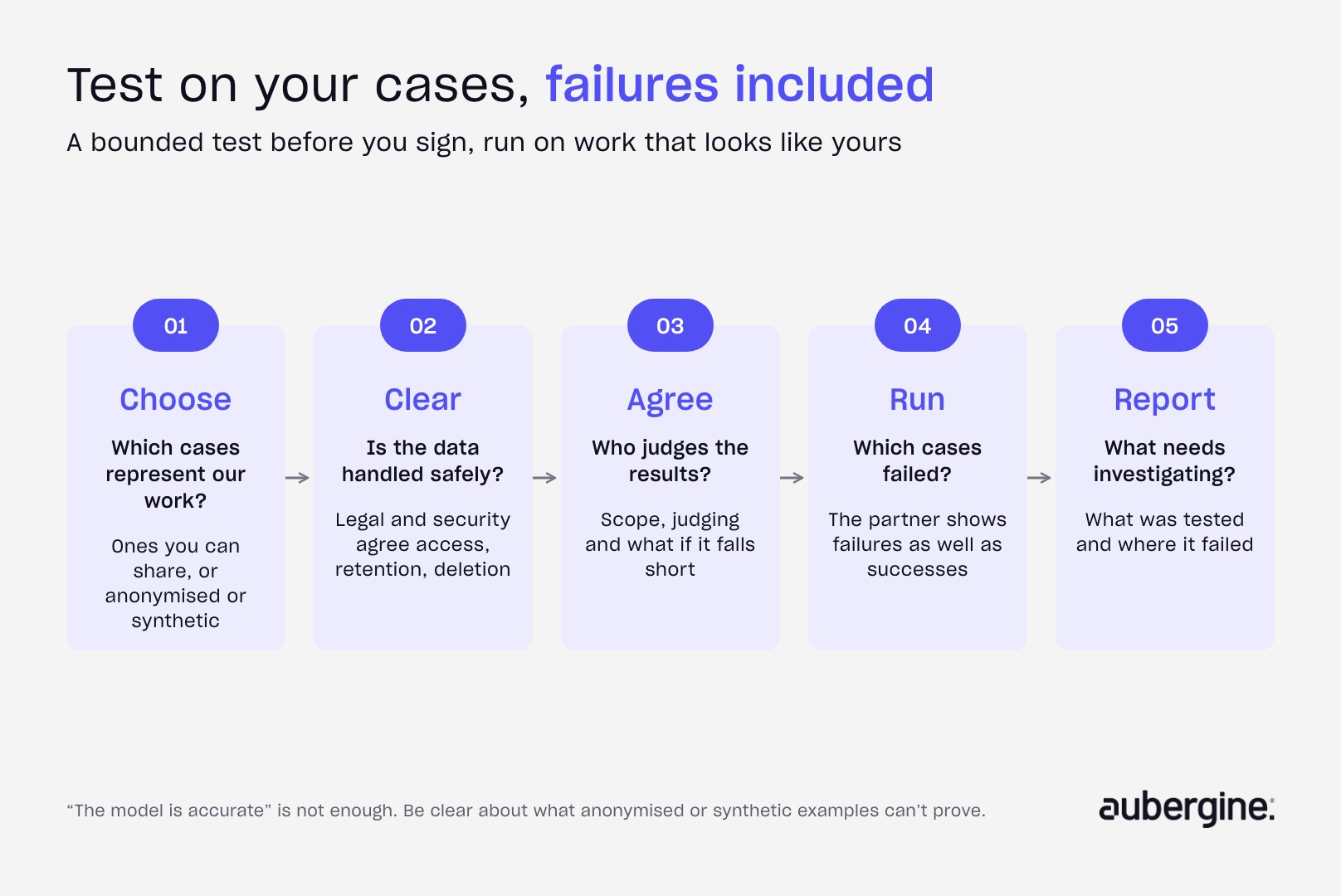
Ask the partner to agree on a bounded test using representative cases you are authorized to share. If sensitive data cannot be used, start with approved, anonymized or synthetic examples and be clear about what they cannot prove. Agree on the scope, who judges the results and what happens if the test falls short. A partner should show the cases that did not work as well as the ones that did. Involve legal and security teams to agree on access, permitted environments, model-provider use, retention and deletion before sharing data.
A good answer is specific: "Here is what we tested, here is where it failed, and here is what we would need to investigate." "The model is accurate" is not enough. Our article on AI evals for AI agents explains the practice in more depth; as a buyer, your job is to ask for evidence that relates to your own use case.
2. Tell me about a project that went wrong. Can I speak to the client?
This is an uncomfortable question for a vendor. It is much easier to bring a polished success story than to discuss a project where the plan did not survive contact with reality. I know the instinct: find a story that sounds difficult but still makes us look perfect.
I would push past that. Ask what the partner was responsible for, when they recognized the problem, what they changed and what the client would say about the experience. A reference conversation depends on the client's consent and confidentiality, so a refusal to disclose a name is not automatically a red flag. The partner should still be able to explain a real situation and its own role without shifting all responsibility elsewhere.
One situation I would discuss, with the client's permission, involved a disconnect between a product owner and executive management. Budget had been wasted and the product's direction was at risk. We were brought in under tight budget constraints to help course-correct execution and strengthen governance around scope.
That was a recovery engagement. It would be misleading to present it as a failure caused by our own team, or to invent a client's verdict. The lesson I take from it is that delivery risk is not always a coding problem. If the people approving the work and the people directing it are not aligned, another sprint can spend money without settling the underlying disagreement.
3. Who is responsible for this system in month seven?
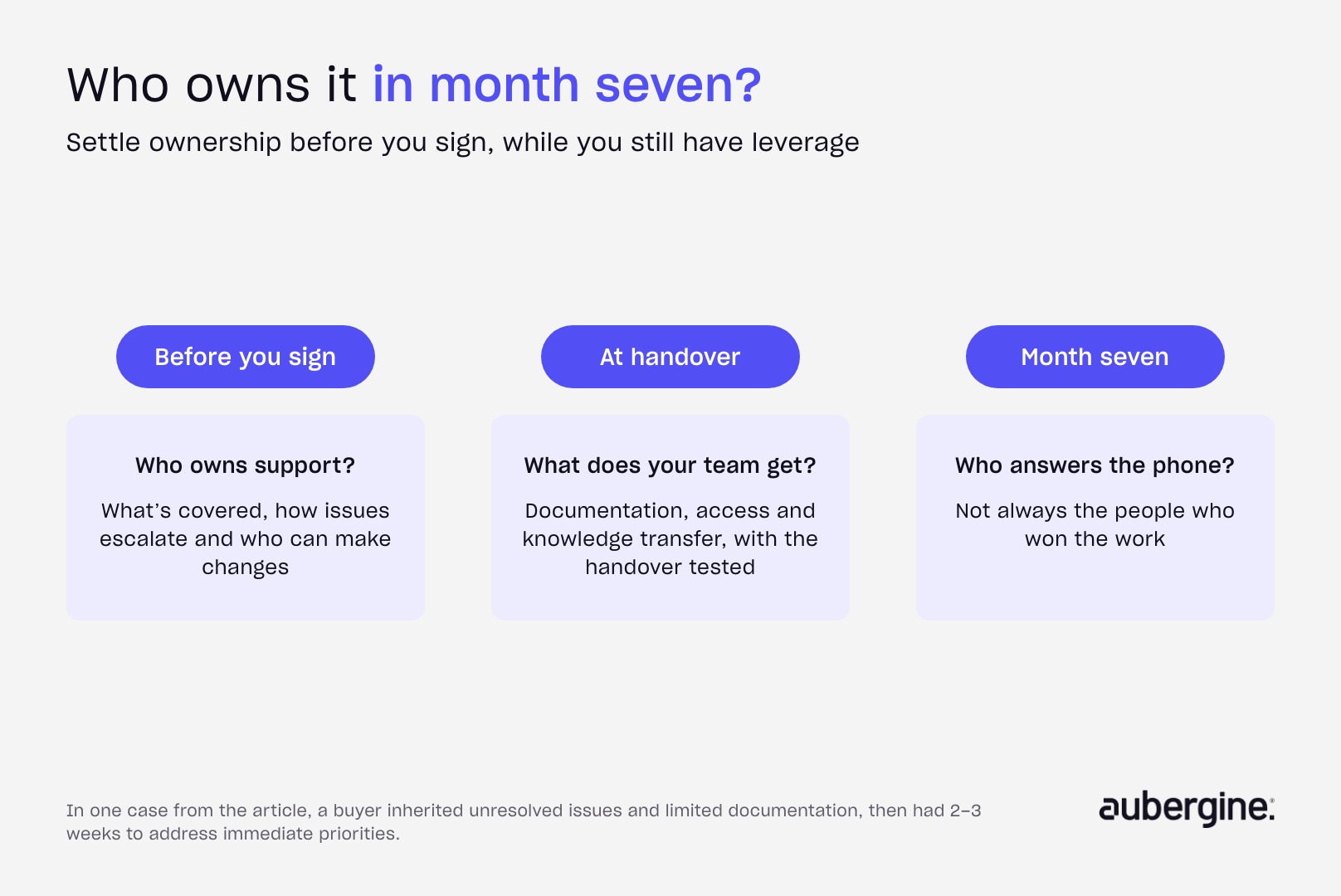
The people who win the work are not always the people who will answer the phone after launch. Ask who owns support, what is covered, how issues are escalated and who can make changes. If your team is expected to take over, ask what documentation, access and knowledge transfer it will receive, and how that handover will be tested.
This question is not theoretical for me. A B2B software company came to us through a referral after an underperforming partner had left critical issues unresolved. The handover and documentation were limited, and our team had a two-to-three-week deadline to address immediate priorities. We met those priorities on schedule and continued in a support relationship.
The buyer had urgent work to do with too little context handed over. Ask about that handover before you sign, when there is still leverage to define it.
What the demo should make you ask next
I don't want buyers to stop asking for demos. I want them to use demos differently.
After you see the happy path, choose a case the presentation did not cover. Ask the delivery team to explain what the user sees if the system cannot complete the task, when a person can review or take control, and where the unfinished work goes. If the partner has not built that path yet, ask what it would take and whether it is included in the proposed scope.
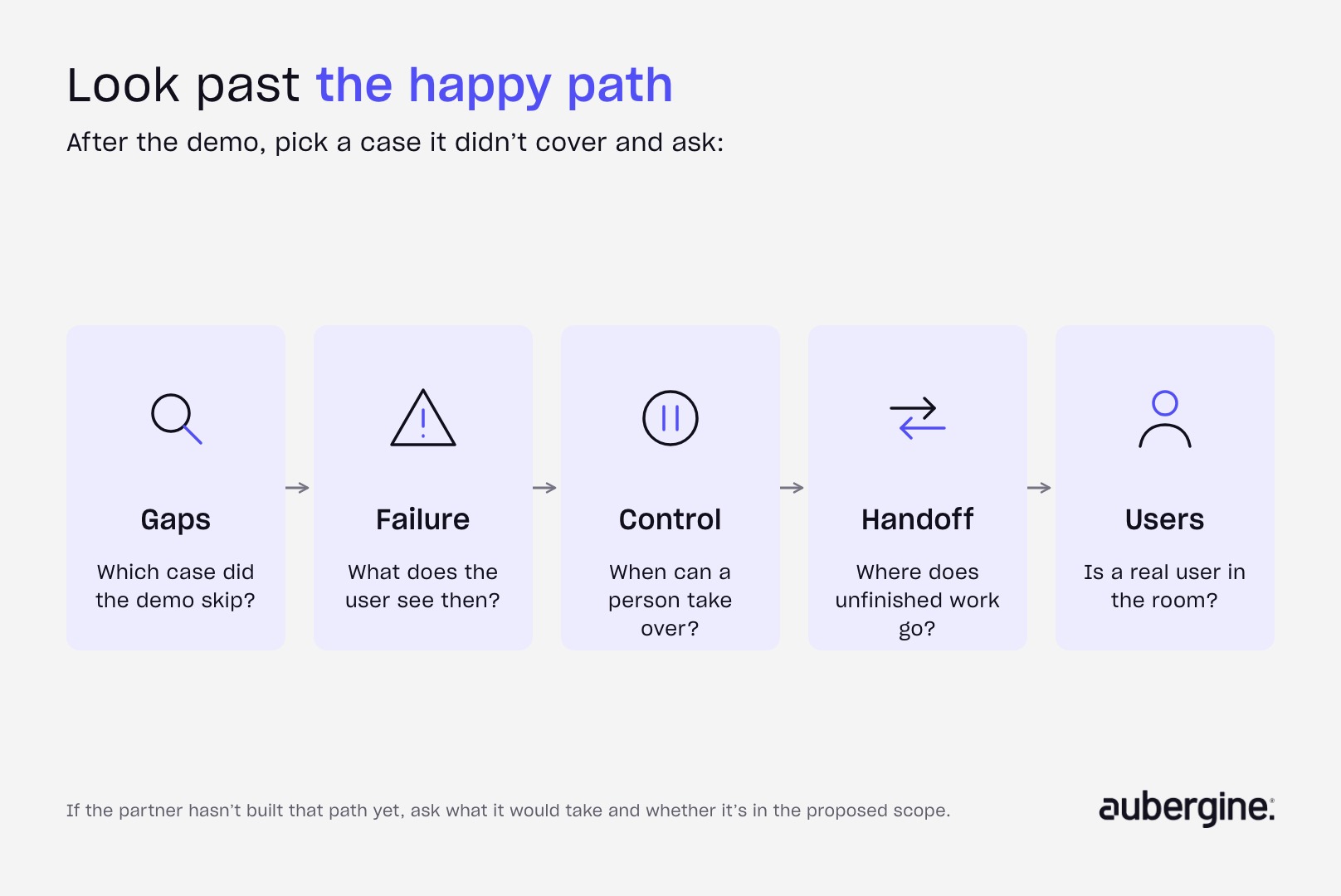
Bring a person who will actually use the system into that conversation. A buyer can be impressed by the technology while the employee doing the work sees an approval step that would slow them down or an error message that gives them no way to recover. Adoption is part of the buying decision, not a problem to hand to the client after launch.
Do the same with the timeline. AI can accelerate prototypes and parts of development. A production system still needs work around the specific workflow, integration, security and support. If a proposal promises an unusually fast launch, ask exactly what "launch" includes. A limited prototype, a pilot with a small group and a production system used across the business are different commitments.
I find the pressure to promise the shortest timeline frustrating, including when it shapes our own sales conversations. A deadline is useful only when both sides agree on the outcome and the work omitted to meet it. If the partner cannot explain that trade-off, the speed is not yet a plan.
What would a partner tell you not to build?
This may be the most revealing part of the conversation. A partner who will build whatever is in the brief is easy to buy from. A partner who understands the business should be willing to challenge the brief when the investment looks weak.
I would be cautious about a product whose core proposition could be absorbed by a single feature from a much larger platform. That does not mean every product in a competitive category is a bad idea. It means I want to understand what would remain valuable to customers if the obvious feature became widely available. If the answer is unclear, I would rather work through that question than rush to quote a build.
The same applies to an AI use case driven mainly by board pressure or fear of missing out. Ask what outcome the business expects, who experiences the problem and how the proposed work changes it. A partner should be able to recommend a smaller test, a different approach or no custom build, even if that reduces its immediate revenue.
When you may not need an AI partner
Sometimes you do not need a custom AI system at all. In discovery, we encounter repetitive tasks where simpler automation could be enough. In other situations, an off-the-shelf tool may offer a better return, or the transaction volume may be too low to justify the ongoing cost of a custom solution.
Your own team may also have the capability and capacity to handle the work. If the workflow is well understood, the risks are manageable and the people responsible can support the solution, buying an external build may add complexity rather than remove it. An external specialist could still help with a specific gap without owning the whole project. Our article on in-house and dedicated product teams explores those choices.
If you do need a partner, we bring strategy, design and engineering together to help clients develop products. Our guide to AI-powered product development describes that work. You should still apply the same questions in this article to Aubergine that you apply to anyone else.
Make the shortlist earn the contract
Before you choose, have each shortlisted team respond to the same business problem. Give them the same approved context and make room for them to question it. Include the business owner, a technical decision-maker and someone who will use or support the system. Compare what you learn as well as the price at the bottom of each proposal.
I would write down the evidence beside each recommendation: what was demonstrated, what was tested on representative work, what remains unknown and who would own the system afterward. Note the limitations of each reference. Ask for the proposed team and support commitments in writing, including the terms under which they can change.
Then make a decision. If the business case is weak, do not buy a custom build yet. If the problem is real but the evidence is thin, agree on a bounded, secure pilot with a business owner, success criteria and a decision point. If the evidence and support plan are sufficient for the risk, move forward with the responsibilities clear.
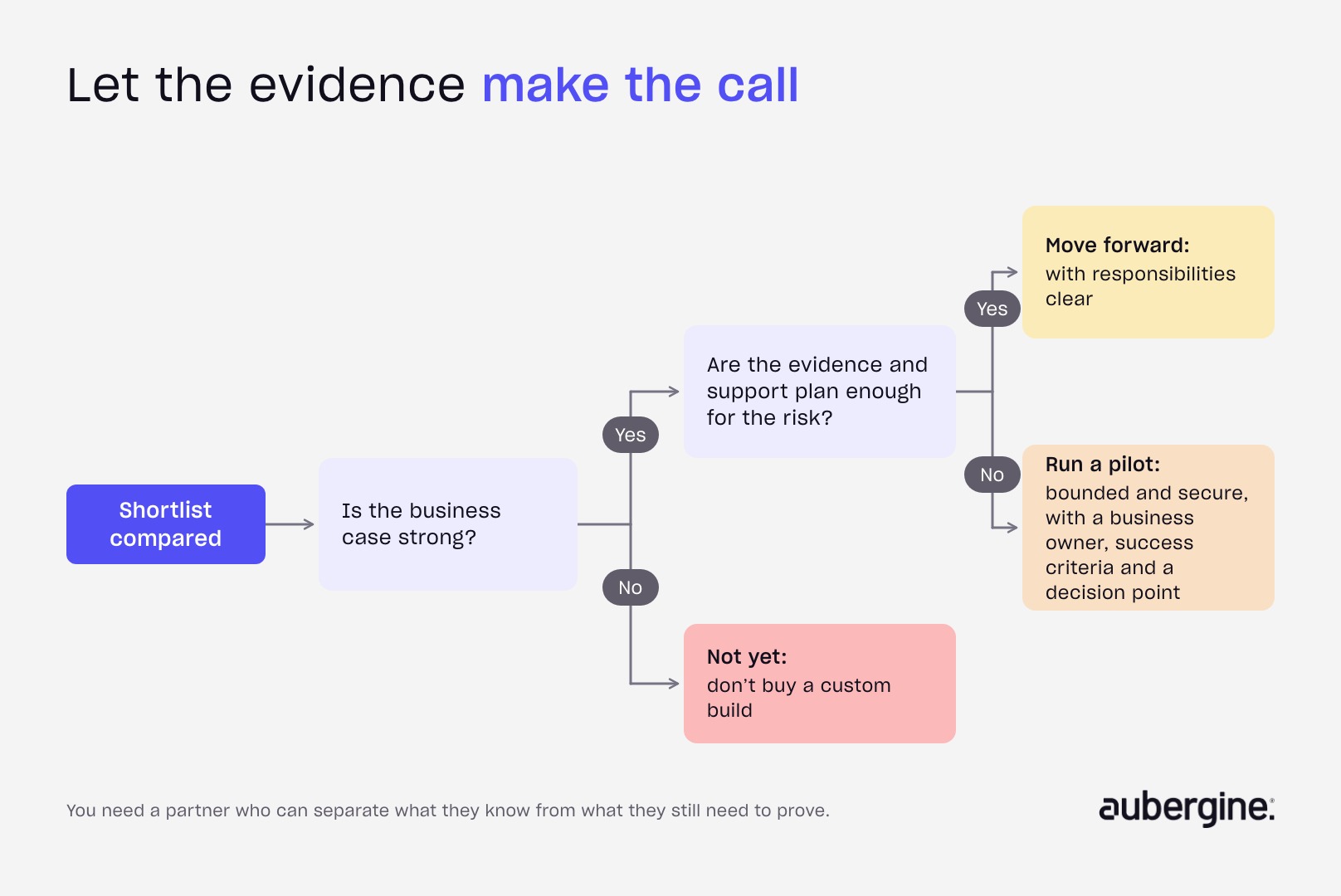
You do not need a partner who has a perfect answer to every question on day one. You need one who can distinguish what they know from what they still need to prove, and who will stay accountable for the work they take on.
Your next step
Take one real workflow to your next partner conversation. Ask each candidate to show what it can prove, where the approach fails and what happens after launch. Use those answers to decide whether to run a pilot, choose a simpler option or stop before committing to a build. If Aubergine is on your shortlist, bring that workflow to us and hold us to the same questions.
FAQs
How do I choose an AI product development company?

Start with the business outcome and compare partners on evidence relevant to that work. Ask to meet the proposed team, review results on representative cases, understand failure handling and agree on ongoing ownership. A demo and a reference help, but neither replaces those checks.
Should an AI partner have experience in my exact industry?
It can be important, especially where local requirements or domain expertise are central to the work. If experience is adjacent, ask the partner to show what transfers and how it will address the gaps. Do not treat a similar logo as proof that the proposed team can solve your specific problem.
Who should maintain an AI system after launch?
That can be your internal team, the implementation partner or another provider. Decide before signing who monitors and supports it, who can make changes, what access and documentation they receive, and how ongoing work is funded.
When should we choose a simpler solution instead of custom AI?
Consider simpler automation, an existing tool or an internal build when it can meet the need at an acceptable cost and risk. Low transaction volumes and limited business value are reasons to question a custom AI investment, not reasons to force a larger project.


Authors

Keerthish N G

More ways to listen


Podcast Transcript