
Every product roadmap wants AI. Yet most AI features fail to change user behaviour. Not because the models aren't capable but because teams start with technology instead of user workflows.
Whether it's a copilot, intelligent search, workflow automation, or a conversational assistant, AI has quickly become a business expectation. As models become more capable and easier to integrate, building AI-powered features is no longer the difficult part.
Building the right AI is.
Many products begin with the technology itself. Teams identify what the latest model can do and then look for places to use it. The result is often an AI feature that works well in isolation but contributes little to the overall product experience.
The strongest AI products take a different path. They start with users, workflows, and business outcomes. Instead of asking, "Where can we add AI?", they ask, "Where can intelligence create meaningful value?"

This shift changes every stage of product development, from identifying opportunities and designing workflows to measuring success long after launch.
Build for friction, not features
The best AI opportunities rarely begin as feature requests.
Users don't ask for document summarisation, semantic search, or AI copilots. They describe the work that's slowing them down. They're frustrated by repetitive tasks, time-consuming document reviews, switching between multiple systems, or spending too long looking for information.
These moments of friction are where meaningful AI opportunities emerge.
Rather than starting with technology, experienced product teams begin by understanding how work actually gets done. They observe recurring bottlenecks, identify repetitive decisions, and look for areas where people spend more time managing information than using it.
A few patterns appear repeatedly across products.
Notice that none of these opportunities start with "build a chatbot." The workflow determines the solution, not the other way around.
Consider a customer support platform. A stakeholder may request an AI assistant to answer customer questions faster. But after observing support teams, the real issue often turns out to be information retrieval. Agents know how to resolve customer issues; what slows them down is finding the right information quickly. In this scenario, improving knowledge retrieval creates significantly more value than replacing the conversation altogether.
The same principle applies elsewhere. A lending platform may benefit more from AI that extracts information from financial documents than one that generates responses. A healthcare application may see greater impact by reducing administrative effort before a consultation rather than introducing another conversational interface.
One pattern we've consistently observed while building AI-powered products is that stakeholders often arrive with a solution ("we need a chatbot"), while users reveal a different problem. More often than not, the highest-impact opportunities come from reducing friction inside an existing workflow rather than introducing a new AI interface.
This way of thinking also protects teams from chasing novelty. Every new model release expands what's technically possible, but technical possibility shouldn't dictate the roadmap. The strongest AI products solve existing problems more effectively rather than creating new features simply because the technology exists.
Understand what AI can (and cannot) do
Finding the right opportunity is only half the challenge. The next decision is determining whether AI should solve it at all.
Large language models have dramatically expanded what's possible, but they're fundamentally different from traditional software. They interpret context, generate probabilities, and produce responses that can legitimately vary between interactions. This flexibility makes them powerful, but it also introduces uncertainty.
Understanding these trade-offs is one of the most important responsibilities of a product team.
This doesn't mean AI has no place in high-reliability systems. It simply means its role changes.
For example, AI may extract information from documents, classify incoming requests, or recommend the next action, while deterministic business logic validates the output before anything reaches the user. In these cases, AI supports the workflow instead of becoming the workflow.
The same thinking applies beyond technical capability. Every AI implementation introduces trade-offs around latency, inference costs, governance, privacy, and long-term maintenance. Sometimes a traditional automation pipeline delivers the same business outcome with greater reliability and lower complexity.
Knowing when not to use AI is just as valuable as recognising where it creates meaningful impact.
Good product judgment isn't about maximising AI usage.
It's about maximising customer value.
Let workflows guide the way
Once a problem has been identified as a strong candidate for AI, the focus shifts from models to experience.
Users don't think in prompts or models. They think in outcomes. They want to complete an application, review a document, resolve a support issue, or make a decision. AI becomes valuable only when it fits naturally into this journey.
That's why successful AI products are designed around workflows rather than standalone features.
Before implementation begins, experienced teams map how information moves through the product. They identify where decisions are made, where uncertainty exists, and where people need support rather than automation.
Instead of immediately asking "Which model should we use?", they ask questions like:
- Where does information enter the workflow?
- Which decisions require human judgment?
- What happens when AI isn't confident?
- Which outputs need deterministic validation?
- How does the experience recover when something goes wrong?
These questions often have a greater impact on product quality than model selection itself.

A useful way to think about this is by separating deterministic systems from non-deterministic ones. Traditional software behaves predictably; given the same input, it produces the same output every time. AI doesn't. Product teams therefore need to design workflows that manage uncertainty instead of exposing it.
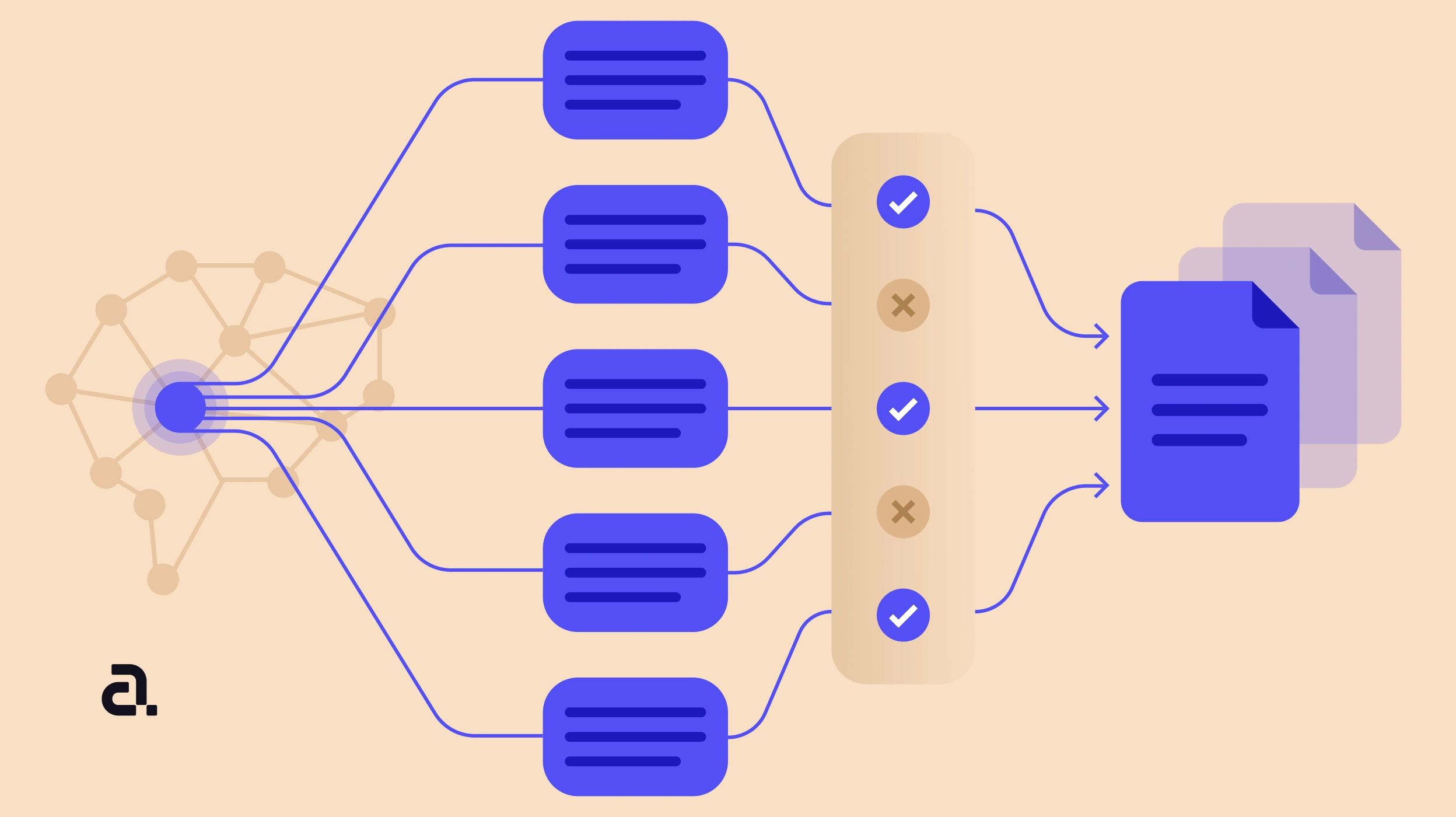
This might mean introducing confidence thresholds, validating outputs against business rules, or routing specific cases to human reviewers. Rather than eliminating people from the process, many successful AI products deliberately keep humans involved where judgment matters most.
Another noticeable shift in modern AI products is that the intelligence itself is becoming less visible.
Instead of asking users to interact with another chatbot, AI quietly drafts responses, extracts information, surfaces relevant context, or recommends the next action inside workflows people already understand. The experience feels less like using AI and more like using software that's simply easier to work with.
This also explains why orchestration has become so important. One lesson we've learned across AI implementations is that the model is rarely the biggest determinant of success. Projects tend to succeed or struggle based on how well retrieval, business rules, user experience, and human oversight work together. The orchestration around the model often matters more than the model itself.
Across the AI products we've helped design and build, one insight has remained remarkably consistent: users don't evaluate AI based on how intelligent it appears. They evaluate it based on whether it helps them complete their work faster, with fewer errors and less effort. That's why workflow design consistently has a greater impact on adoption than adding more AI capabilities.
In our article on How we used AI-driven workflow automation to improve product workflows, one lesson stood out: the quality of the workflow consistently had a greater impact on the product than the sophistication of the model.
Ultimately, models make AI possible. Workflows make AI useful.
Keep outcomes in the crosshairs
One of the biggest challenges in AI product development isn't building the first version. It's ensuring the product still solves the same problem six weeks into development.
AI projects naturally evolve. New model capabilities unlock fresh possibilities, stakeholders identify additional use cases, and engineers discover interesting technical opportunities along the way. While this exploration is valuable, it can also shift the focus from solving a user problem to showcasing AI capabilities.
This is why experienced product teams build regular validation checkpoints into the project. These aren't just technical reviews; they're opportunities to reassess whether the product is still creating the value it set out to deliver.
A few questions can quickly reveal whether a project is on track:
- Are we still solving the original user problem?
- Has AI simplified the experience or made it more complex?
- Does the additional intelligence justify the implementation effort?
- Would we make the same product decisions if we started today?
These conversations help teams avoid feature creep while giving them the confidence to simplify when necessary.
AI also plays an increasingly important role before implementation begins. Product teams are using it to accelerate research, explore user journeys, identify missing edge cases, and evaluate alternative workflows. It becomes another tool for product thinking rather than the product itself.
The final decisions, however, remain human. Product strategy, customer context, business priorities, and trade-offs can't be delegated to a model. AI can generate possibilities; product teams determine which ones are worth pursuing.
Measure what matters
Unlike traditional software, AI products can't be evaluated on delivery alone.
Success isn't defined by whether the feature shipped or whether the model achieved high benchmark scores. It's defined by whether users complete their work more effectively than before.
This means measuring both the health of the AI system and the health of the product.
Both perspectives matter because strong technical performance doesn't automatically create business value.
An AI feature may deliver highly accurate responses, but if it slows down an existing workflow or requires users to change established behaviour, adoption will suffer. Likewise, a model with slightly lower accuracy may create significantly more value if it reduces hours of repetitive work and fits naturally into the product experience.
It's also important to recognise that success metrics change as products mature. During a proof of concept, teams are validating technical feasibility. Once the feature reaches production, the conversation shifts towards reliability, operational efficiency, customer adoption, and measurable business outcomes.
The most successful AI teams define these metrics early, revisit them throughout development, and continue refining them after launch. Measuring the right outcomes doesn't just validate success—it creates a feedback loop that guides future iterations.
Iterative learning, no snap judgements
Building AI products isn't a one-time implementation exercise.
Models improve, user behaviour evolves, and entirely new approaches emerge within months. Teams that treat AI as a finished capability quickly fall behind. Those that treat it as an evolving product continue improving long after the first release.
Iteration becomes a competitive advantage.
Every production deployment uncovers new edge cases, reveals unexpected user behaviour, and highlights opportunities to simplify workflows or strengthen guardrails. These learnings shape future releases and gradually make the product more reliable.
One practice that's becoming increasingly valuable is maintaining a repository of failures. Documenting unsuccessful experiments, unexpected model behaviour, rejected architectural decisions, and production learnings helps teams build institutional knowledge instead of repeatedly solving the same problems.
Over time, these learnings become just as valuable as technical documentation. They help product and engineering teams make faster decisions, identify recurring patterns, and approach new AI initiatives with greater confidence.
The goal isn't to build a perfect AI product on the first attempt. It's to build a product that gets better with every iteration.
Conclusion
As AI becomes more accessible, building AI-powered features will become increasingly straightforward. Building AI that creates meaningful business value won't.
The products that succeed won't necessarily use the newest models or the largest context windows. They'll be the ones that begin with a clear understanding of user needs, identify opportunities through operational friction, introduce AI where it genuinely adds value, and design workflows that balance intelligence with reliability.
Just as importantly, they'll continue validating outcomes, measuring the right metrics, and learning from every release instead of treating AI as a one-time implementation.
Because the AI products people remember aren't the ones that showcase the most intelligence. They're the ones where intelligence quietly fits into existing experiences, removes friction, and helps users accomplish more without asking them to work differently.
This is what building AI that matters really looks like.
Let’s identify where AI can reduce friction, improve experiences, and create measurable impact for your product. Talk to our AI expert.
FAQs
How do you identify AI opportunities in product development?

The best AI opportunities emerge from understanding user workflows rather than starting with AI technology. Look for repetitive tasks, information overload, manual decision-making, document-heavy processes, or bottlenecks where AI can reduce effort and improve outcomes.
What makes an AI feature valuable to users?
A valuable AI feature solves a real user problem and fits naturally into existing workflows. Instead of introducing AI as a standalone capability, successful products use AI to reduce friction, save time, improve decision-making, and simplify everyday tasks.
When is AI the right solution for a product?
AI is most effective when a problem involves language, context, ambiguity, or repetitive cognitive work. It may not be the best choice for workflows that require deterministic outputs, strict regulatory compliance, or where traditional automation can achieve the same outcome more reliably.
Should every product include AI features?
No. AI should only be introduced when it creates measurable value for users or the business. Adding AI because it's trending often results in unnecessary complexity, while workflow-focused solutions typically deliver better adoption and ROI.
How can product teams validate AI opportunities before development?
Before building, product teams should evaluate: The user problem being solved, Whether AI is the right approach, Available data quality, Human oversight requirements, Expected business outcomes, Success metrics such as time saved, adoption, and operational efficiency. This helps avoid building AI features that are technically impressive but rarely used.
How should AI be integrated into product workflows?
Rather than creating separate AI experiences, successful products embed AI within existing workflows. Examples include drafting responses, extracting information from documents, surfacing relevant knowledge, or recommending next actions without disrupting how users already work.
What are the biggest mistakes companies make when implementing AI?
Common mistakes include: Starting with the technology instead of the user problem, Building AI features without validating business value Ignoring workflow design, Overlooking human oversight, Measuring technical performance instead of user outcomes. Successful AI implementations begin with customer needs and continuously iterate based on real-world feedback.
Can AI replace traditional automation?
Not always. Traditional automation is often more reliable for structured, rule-based tasks. AI works best where interpretation, language understanding, recommendations, or contextual decision-making are required. In many products, the most effective solution combines deterministic automation with AI-powered intelligence.
Why is workflow-first thinking important for AI product development?
Workflow-first thinking ensures AI enhances how users already work instead of forcing new behaviors. By focusing on reducing friction within existing processes, product teams can build AI experiences that drive higher adoption, better productivity, and stronger business outcomes.


Authors

Aaditya Brahmbhatt

More ways to listen


Podcast Transcript