
"The device worked for two days. Now it won’t sync, support isn’t responding, and I’ve basically paid to troubleshoot your product for you."
Sounds familiar? This isn’t just another product review. It tells a deeper story that teams building connected products ought to be listening to more carefully. In these cases, the issue is rarely limited to a single technical failure. By the time a customer writes a review like this, trust has already started to break down.
Connected products occupy deeply personal spaces in people's lives. They support sleep routines, fitness goals, health monitoring, home automation, family care, and everyday habits. When something goes wrong, users do not experience it as a technical issue. They experience it as an interruption to routines they depend on.
That is why a Bluetooth connectivity problem, a failed onboarding flow, or a recurring sync issue often carries emotional consequences far beyond the underlying bug itself.
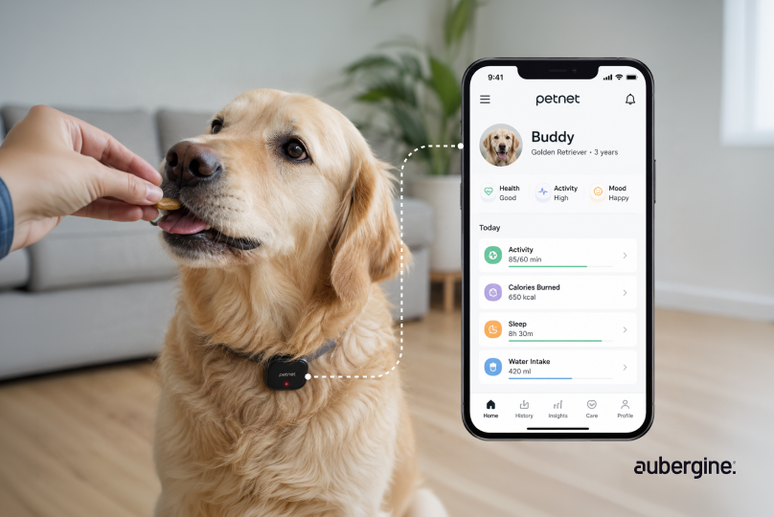
History offers several reminders of how quickly these situations can escalate. In 2016, smart pet feeder company Petnet experienced a cloud service failure that left customers unable to reliably feed their pets through the connected system. What began as a technical issue quickly became a trust issue because customers relied on the product for real-world responsibilities.
The challenge is that many organizations still treat launch day as the moment risk disappears. In reality, launch is often the first moment risk becomes visible.
Before launch, products operate within controlled environments. After launch, they enter a world of fragmented Android devices, unstable Bluetooth environments, poor WiFi conditions, outdated firmware versions, accessibility challenges, and unpredictable user behavior.
Products that appear stable internally often struggle when exposed to real-world variability.
Research reinforces how common this pattern has become. According to Faeth Executive Coaching, nearly 66% of technology and software projects experience partial or complete failure.
Launch does not eliminate uncertainty. It simply exposes products to it for the first time.
The launch myth: Why connectivity issues appear after release
Most launch plans focus heavily on getting products into customers’ hands. Far fewer focus on what happens once customers start using them.
The assumption is understandable. Teams spend months validating firmware, testing applications, fixing defects, completing certifications, and preparing releases. By launch day, it can feel as though the hardest work is behind them.
The reality is often very different.
Before launch, teams operate under relatively predictable conditions:
- Controlled testing environments
- Internal testing devices
- Stable network conditions
- Known firmware versions
- Technically informed testers
After launch, the environment changes dramatically.
Products must suddenly function across:
- Hundreds of Android device variations
- Multiple operating system versions
- Unstable Bluetooth connectivity conditions
- Inconsistent WiFi environments
- Varying accessibility needs
- Users with different levels of technical confidence
A connection failure that never appeared during internal testing may suddenly emerge at scale. Bluetooth connectivity issues that seemed minor in QA may affect thousands of users simultaneously.
The challenge is not necessarily that testing was inadequate. The challenge is that real-world conditions are impossible to fully replicate before release.
This is particularly true for BLE-based products where device compatibility, operating system behavior, battery optimization settings, and environmental interference all influence performance.
Launch day does not represent the end of product validation. It marks the beginning of validation under real-world conditions.
Engineering complete does not mean product ready
Many organizations mistake technical completion for operational readiness.
A launch checklist often focuses on questions such as:
- Is the firmware stable?
- Has the application passed QA?
- Does pairing work correctly?
- Has certification been completed?
- Has the release build been approved?
These questions matter, but they represent only part of launch readiness.
Connected devices require an operational layer that extends beyond engineering delivery.
Real launch readiness also includes:
- Support readiness
- Monitoring readiness
- Analytics readiness
- OTA readiness
- Rollback readiness
- Escalation workflows
- Communication planning
This distinction becomes important when unexpected issues inevitably appear.
Even the most thoroughly tested products encounter edge cases after launch. The difference between a minor incident and a major customer trust problem often depends on how quickly teams can identify, diagnose, communicate, and resolve the issue.
Successful launches are rarely defined by the complete absence of problems. They are defined by an organization's ability to recover when problems occur. Launch success depends on recovery capability, not just release quality.
The business cost of connectivity problems
Technical issues rarely remain technical for long.
A connectivity problem quickly becomes an onboarding problem. An onboarding problem becomes a retention problem. A retention problem eventually becomes a business problem.
Connected devices depend on consistency because users build habits around them. Sleep tracking, activity monitoring, medication reminders, pet care systems, and smart home automations all rely on reliable interactions. When these interactions fail repeatedly, users begin questioning whether the product can be trusted at all.

Pairing failures often lead to onboarding abandonment, lower app ratings, and increased return rates. Sync instability, on the other hand, creates a different challenge. Users may still retain the product, but engagement begins to decline because the experience no longer feels dependable. Habits become disrupted, and usage gradually decreases.
Firmware issues create operational strain by generating support tickets, emergency patch cycles, and engineering interruptions that divert resources away from planned development. Operating system compatibility failures introduce a whole new layer of complexity. Customers rarely distinguish between a platform limitation and a product defect. From their perspective, the product simply stopped working.
The consequences extend beyond engineering metrics:
- Reduced engagement
- Retention decline
- Increased support costs
- Subscription churn
- Negative word of mouth
- Longer acquisition payback periods
- Long-term brand damage
The story of Logitech's Harmony Link highlights how fragile customer trust can become. When support for the product was discontinued, customers faced the prospect of losing core functionality in devices they had purchased. The backlash demonstrated that connected products are ultimately trust products. Once trust erodes, recovery becomes difficult.
Store reviews are operational intelligence for connected devices
Many teams treat app store reviews as marketing metrics.
They are often far more valuable than that.
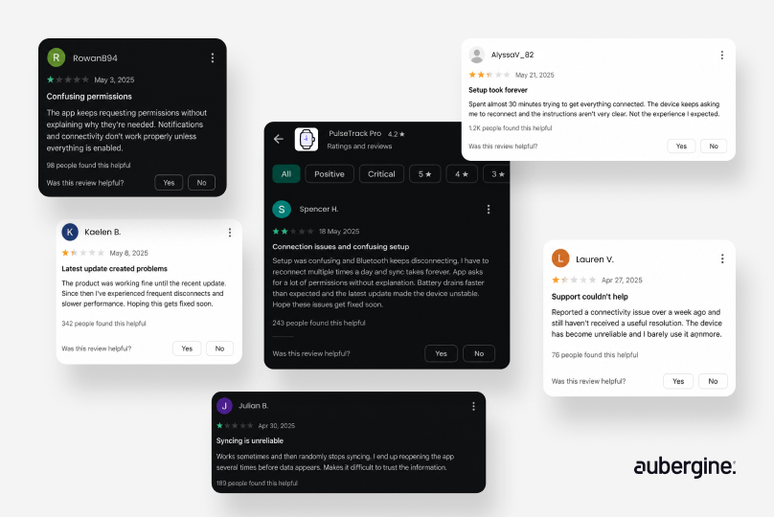
Reviews provide a direct window into how products perform under real-world conditions. Customers describe experiences rather than technical root causes, which often reveals issues that internal teams may overlook.
Reviews frequently expose:
- Setup failures
- Onboarding confusion
- Reliability complaints
- Permission issues
- Sync delays
- Battery concerns
- Firmware instability
Individually, these reviews may appear anecdotal. Collectively, they become a powerful form of operational telemetry.
Patterns emerge quickly. Teams begin to understand which onboarding steps create friction, which Bluetooth connectivity problems appear most frequently, and which aspects of the product users care about most emotionally.
For connected devices, this matters because trust compounds in both directions. Positive experiences build confidence over time, while recurring frustrations accelerate abandonment.
According to analysis published by Beyond Agile Leadership, 99.5% of consumer mobile applications fail to achieve meaningful long-term success. Connected products face the same reality. Sustained adoption depends on continuously reinforcing trust after launch.
Why most teams miss connection failure signals
The challenge is rarely a lack of effort. More often, it is a lack of alignment.
Launch ownership frequently becomes fragmented across engineering, QA, product, support, operations, and leadership teams. Each function focuses on its own responsibilities, but few teams maintain complete visibility across the post-launch experience.
This fragmentation creates predictable gaps:
- No rollback planning
- Immature OTA workflows
- Isolated support data
- Ignored app analytics
- Weak escalation systems
- Reactive support models
As a result, many organizations optimize for shipping velocity rather than recovery velocity. They know how quickly they can release software but not how quickly they can detect emerging connectivity issues. They track sprint metrics closely but lack visibility into onboarding abandonment or Bluetooth reliability trends.
The result is delayed detection, delayed recovery, and delayed communication. Small problems become larger problems simply because nobody sees them early enough.
The new definition of launch readiness for connected devices
Launch readiness has evolved significantly. Traditional thinking focused on shipping a stable release. Modern connected products require teams to think beyond deployment and toward recoverability.
This shift changes how organizations evaluate risk. Instead of asking whether issues might occur, mature teams ask how quickly they can identify, communicate, and recover from them. Trust becomes a continuous operational responsibility rather than a launch milestone.
Post-launch operations framework for Bluetooth connectivity and recovery
Strong connected product teams treat post-launch operations as part of the product itself. A practical framework typically includes three components.
Staged rollout strategy
Rather than releasing updates to all users simultaneously, mature teams gradually expand exposure; from 10%, to 25%, to 50%, and eventually, to 100%. This approach limits risk while providing early warning signals before widespread impact occurs.
OTA management strategy
Effective OTA workflows focus on recoverability rather than deployment speed.
Key capabilities include:
- Staged firmware deployment
- Targeted recovery actions
- Rollback capability
- Rapid unblock workflows
- Minimizing customer impact during patching
Operational observability
Visibility determines recovery speed. Teams need systems that continuously monitor:
- Issue dashboards
- Crash reporting
- BLE reliability tracking
- Support categorization
- Release gates
- Escalation workflows
Beyond failure itself, the biggest risk in connected products is delayed recovery after failure.
Recovery defines trust
Launch day is not the finish line for connected products. The real test begins when products enter unpredictable environments, encounter real-world connectivity issues, and become part of users' daily routines.
The companies that succeed are not necessarily the ones that avoid every Bluetooth connectivity problem, WiFi issue, or connection failure. They are the ones that just detect issues faster, recover more effectively, communicate transparently, and rebuild trust consistently.
In connected ecosystems, operational readiness becomes part of the product experience itself.
A stable launch matters. The ability to recover after launch matters even more.
If this topic resonates, you may also enjoy "Why most BLE products fail in the real world (even after passing QA)," which explores how many connected devices struggle not because of hardware defects, but because real-world user experiences expose challenges that controlled testing environments rarely uncover.
Planning a connected product launch or scaling an existing ecosystem?
Let's evaluate your readiness across app stability, Bluetooth reliability, OTA recovery, observability, and post-launch operations to help reduce risk and improve long-term product performance.


Authors

Harsh Soni

More ways to listen


Podcast Transcript